
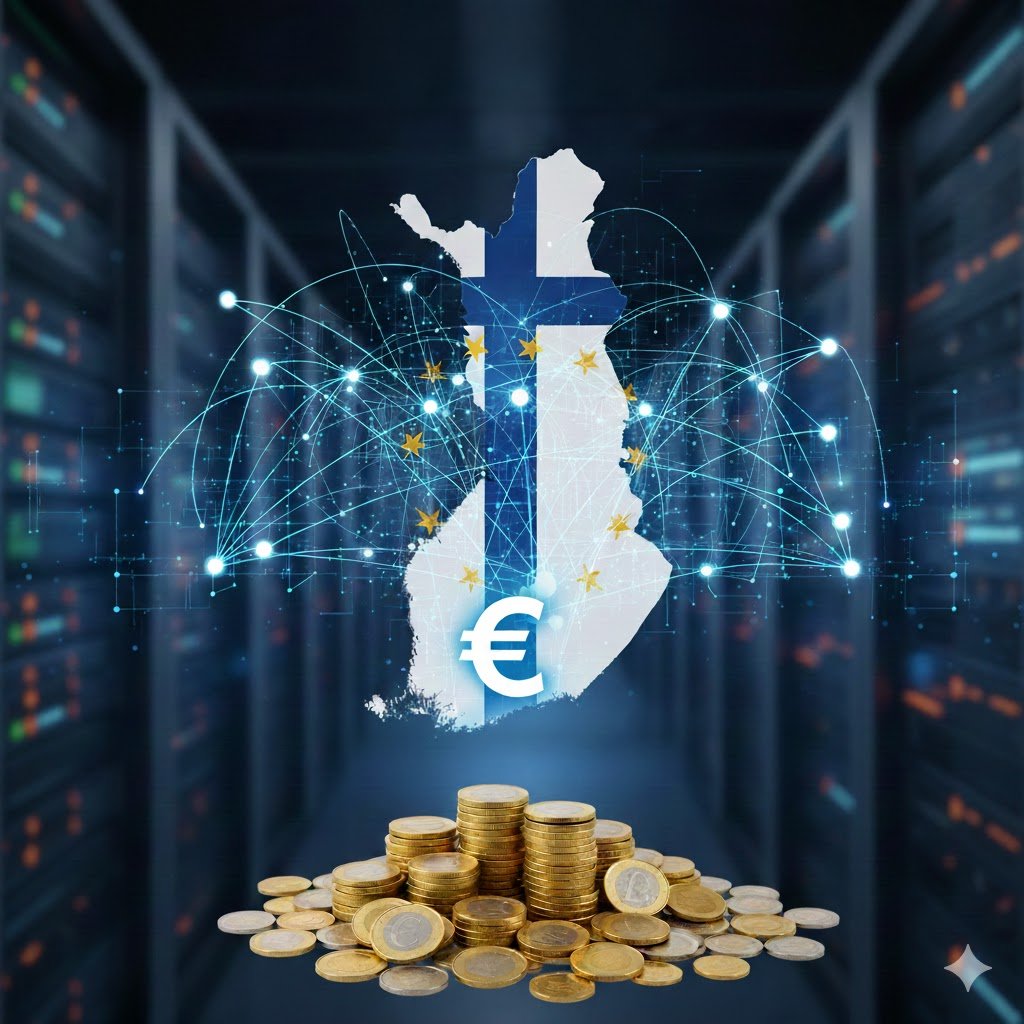
European Union is facilitating the Finland to strengthen its digital backbone with new supports. A large share of the funding is dedicated to the upgrading of the communication network which will be the EU’s network of the future in the next years with high capacity links and the digital cross-border infrastructures of tomorrow.
Five projects led by Finnish entities were selected for funding in the fourth CEF Digital calls. They focus on submarine cables, fibre expansion, quantum-secure links, and 5G usage. Besides, a cable project led by Sweden, partially located in Finnish waters, will be of some advantage to Finland too.
According to the Ministry of Transport and Communications, the aid strengthens the EU’s resolve to provide secure, resilient and high-capacity digital links between the member states. The projects selected for Finland signal the country’s long-standing focus on digital readiness, connectivity, and secure information exchange.
Strengthening Nordic connections
Improving both physical and digital connections with neighbors will absorb most of the money direct allocated to Finland. DNA Oyj has been given EUR 1.62 million to modernize the land-based backbone network between Finland and Sweden. The project involves the mutual border area strengthening of land routes in order to increase both the dependability and the backup capability, thus citizens and businesses on both sides of the border will experience almost no interruptions.
On the other hand, Elisa Oyj will be given EUR 1.15 million for the development of the fibre-optic infrastructure in the north of Finland. The activity will establish numerous new interfaces for the connection of the fibre networks with Sweden and Norway. The officials confirmed that the investment would help to improve the accessibility of the Internet in the less densely populated areas of the Arctic thus not only local communities would be supported but also the whole economy would benefit.
Arctic ambitions with Polar Connect
The three countries Finland, Sweden, and Denmark are involved in the cooperation to design the Polar Connect submarine cabling project, which aims to create a brand new route through the Arctic region for data traveling under the sea. The overall amount of money given for the project is EUR 4.97 million, but only about EUR 91, 000 are reserved for the Finnish operators, including the Finnish IT Center for Science.
The cable is very likely to facilitate global data traffic by providing a shorter and more secure route between Europe and Asia. In this round, the financed planning work will also comprise the cable route determination as well as the preparation of the technical descriptions for the next construction.
Pioneering quantum-safe infrastructure
Among the projects financed by the EU, one project aiming at quantum-safe cryptographic key transmission grabbed the most attention. The first step on this route is the joint project of Finland, Estonia, and Sweden, in which scientists intend to create the most advanced and strongest communication links invulnerable to quantum attacks across borders – as a necessary step because, emerging quantum technologies, as they become more, pose more and more significant threats to the traditional encryption methods.
Finland’s portion of the total EUR 4.99 million award is somewhere around EUR 1.49 million. Among the main contributors are VTT Technical Research Centre, Erillisverkot, and the Finnish IT Center for Science. The scope of work includes protecting the most vulnerable areas of the public sector and the research sector against potential cyber threats of the future.
Building a cross-continent 5G corridor
Telia Finland and Telia Towers Finland have decided to be part of an EU-wide experiment to form a 5G corridor from Scandinavia to Germany and then to Luxembourg and Czechia. The project as a whole, is assigned a budget of EUR 3.35 million, and out of that, the Finnish involvement will be supported with approximately EUR 344,000.
By using this corridor, the continuation of the 5G signal along the main transit routes will be guaranteed thus safety will be enhanced and new services for autonomous vehicles, logistics as well as emergency responding will be possible.
Protecting Baltic Sea infrastructure
Besides, Finland will not be left out of the benefits either from the Swedish-coordinated Baltic Offshore project which was awarded EUR 1.64 million. The project aims at the implementation of a comprehensive plan that is able to ensure the safety of submarine cables in the Baltic Sea – such as the case may be, for instance – they are the main trusses of the digital infrastructure of Europe that are increasingly vulnerable both in terms of nature and politically.
What comes next?
The fifth call for proposals within the CEF Digital program is not far off. The Finnish Transport and Communications Agency, Traficom, will post the opening date on his website.
Officials are convinced that the rounds of EU funding still to come are a perfect demonstration of the strong drive for Europe’s digital transformation. Thus, for Finland, the latest aid is an additional confirmation of the country’s position as a northern digital hub—the Arctic, the Nordic region and the rest of the EU being linked through resilient, secure and high-capacity networks.