
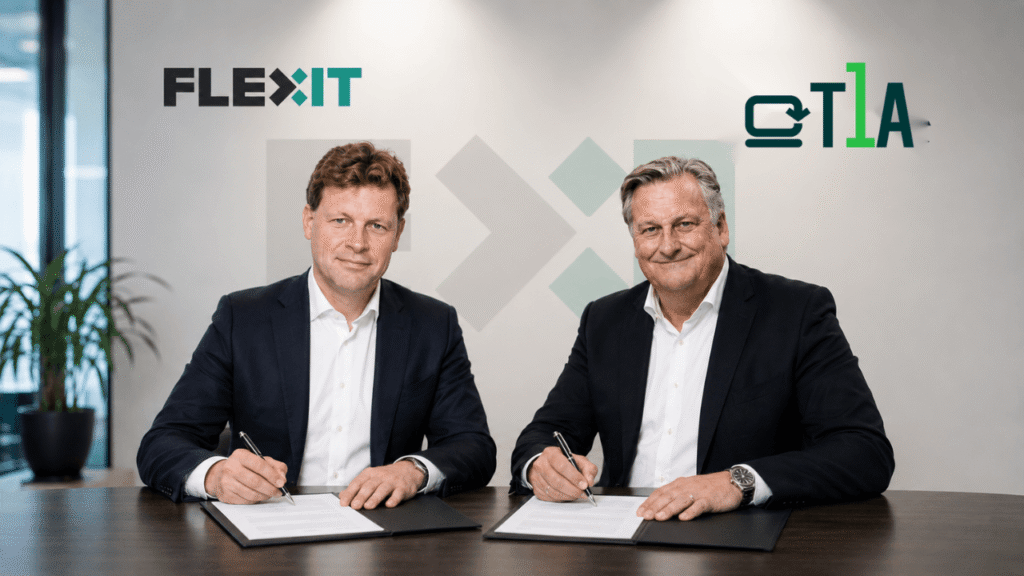
The combination brings together two companies operating at different stages of the IT hardware lifecycle, creating a business that can recover corporate devices, securely process them, refurbish them and return them to the European market. The move comes as businesses face growing pressure to reduce electronic waste, improve the value recovered from technology assets and adopt more sustainable IT procurement models.
Closing the IT Lifecycle
T1A Group, founded in Denmark in 2001, specialises in recovering corporate IT equipment at the end of its first use. Its operations include secure data erasure, refurbishment and preparation of devices for a second life. The company describes its business model as being built around asset recovery, refurbishment and distribution, with a focus on extending the useful life of electronics and reducing electronic waste.
Flex IT, founded in the Netherlands in 1991, operates across Europe as a supplier of new and refurbished IT hardware. Its offering covers refurbished products, new hardware, rental services, demo equipment and IT asset disposition services, allowing businesses to manage several stages of the technology lifecycle through one provider.
The combination effectively connects these capabilities. Corporate hardware collected by T1A can now move through the combined group’s certified processing infrastructure before being distributed through Flex IT’s European reseller network.
Building a Circular IT Platform
Flex IT has increasingly positioned itself around the circular economy, with services designed to recover devices, securely wipe data and give hardware another useful lifecycle. Its circular IT portfolio includes refurbished and remanufactured products, buyback programmes, IT asset disposition, rental and demo services.
The company says its refurbishment process involves repairing or replacing damaged components, cleaning and testing devices, and updating software and firmware. Refurbished products are supplied with warranties and certified data wiping.
T1A similarly focuses on professional refurbishment and resale. The company says it uses testing and quality control processes to ensure refurbished electronics meet industry standards, while providing warranties and support to customers.
Certified Processing Across Europe
Both businesses hold R2v3 certification, supporting the combined group’s focus on traceability, secure processing and responsible handling of IT assets. Flex IT says its R2v3 certification provides transparency and traceability across IT asset disposition, including how devices are processed, reused and recycled.
The combined group will operate certified processing capabilities across Denmark, the Netherlands and Poland. Flex IT already operates a circular centre in Toruń, Poland, which it opened in 2021 to strengthen its European refurbishment operations.
New Leadership Structure
As part of the combination, Angelo Bul, Chief Executive of Flex IT, becomes Chief Executive Officer of the combined group. Peter Hemicke, founder of T1A, takes the role of Executive Chairman, where he will focus on group strategy while continuing as a co investor alongside Eurazeo’s Planetary Boundaries Fund.
The transaction is backed by the Eurazeo Planetary Boundaries Fund, which acquired a majority stake in T1A in May 2026 and has now funded the acquisition of Flex IT with support from Dansk Vækstkapital. Eurazeo has described T1A as a platform for building a leading European IT asset disposition business through organic growth and targeted acquisitions.
Targeting Europe’s Circular IT Market
The new group aims to make it easier for companies to move away from the traditional buy, use and discard model. Flex IT argues that many devices remain capable of delivering value beyond conventional replacement cycles, making refurbishment and reuse both an environmental and commercial opportunity.
With recovery, refurbishment and distribution now brought under one structure, the combined company will seek to maximise the value of corporate hardware while reducing waste. Its European footprint and established reseller relationships also provide a route to move second life devices into markets where they can continue to generate value.
The transaction marks another step toward a more integrated European circular IT ecosystem, where extending the life of technology becomes part of the standard corporate hardware lifecycle rather than an afterthought.