
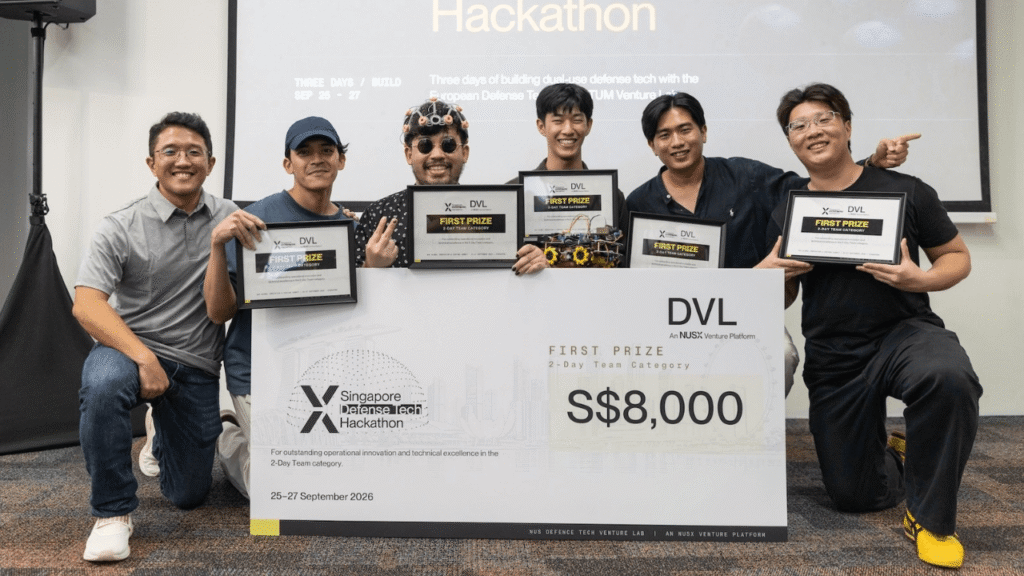
A university campus may not be the first place that comes to mind when thinking about the future of defence technology. However, Singapore is increasingly using its research institutions and startup ecosystem to bring engineers, entrepreneurs and military specialists together to develop technologies for complex security challenges. A recent defence technology hackathon organised by the European Defense Tech Hub (EDTH), the National University of Singapore (NUS), NUSX and Munich’s TUM Venture Labs demonstrated how quickly experimental ideas can move towards potential commercial applications.
The event attracted more than 1,000 applicants, with approximately 300 participants selected. It featured two competitions, a 48 hour challenge involving 39 teams and a three month extended programme involving 22 teams. More than S$50,000 in prizes was awarded, alongside opportunities for promising teams to explore startup development.
From Brain Controlled Robots to Drone Technology
The competition produced a wide range of prototypes involving robotics, artificial intelligence, autonomous systems and surveillance.
NeuroMech won the shorter challenge with a brain computer interface designed to control unmanned ground vehicles through signals generated by the human brain. The concept uses sensors positioned near the visual cortex to detect responses to visual signals and translate them into commands for a robotic vehicle.
The team’s demonstration explored how operators could control machines without relying on conventional joysticks or voice commands. Although the technology remains experimental, it highlights the potential of combining neuroscience and robotics for specialised applications.
Another project, SmartFalcon, developed a low cost drone interception concept using commercially available components and onboard computer vision. The team estimated that an individual unit could cost approximately S$470, demonstrating the competition’s focus on making advanced technologies more affordable.
MAELSTROM Wins the Extended Challenge
The three month competition was won by MAELSTROM, a five member student team developing a rocket propelled interceptor concept designed to address large groups of unmanned aerial vehicles.
The project focused on combining engineering design with affordable manufacturing. The team explored the use of 3D printing for components and propellant related development, alongside a networked command and control concept.
Despite joining the extended challenge with only five weeks remaining, the students produced an inert prototype and secured the S$10,000 top prize.
Project lead Vaikesh Manimaran said that bringing together different engineering disciplines was central to the team’s progress. The group is now exploring opportunities to develop its work further, including the possibility of creating a defence technology startup.
Why Collaboration and Interoperability Matter
One of the competition’s distinctive features was the Lord of the Rings prize, which recognised teams that combined separate technologies into a broader operational capability.
In the shorter challenge, Acoustics, DomeCommand and AEGIS collaborated on a concept connecting acoustic sensing, AI based command systems and autonomous platforms. Their work explored how different sensors and decision support technologies could contribute to a shared operational picture.
The extended challenge collaboration between SwarmBreakers and Sentinel focused on improving radar tracking and operator decision support. Their simulated demonstration reported 95 fewer tracks and a reduction of approximately 40 to 45 per cent in task completion time.
These projects illustrated the importance of interoperability, particularly when multiple autonomous systems and information sources need to work together.
Beyond Defence, Supporting Civilian Safety
Not every project focused on military applications. Team Felix presented a civilian emergency response platform designed to help people identify safer locations during floods, extreme rainfall and other emergencies.
The concept included real time shelter recommendations, crowd management and the potential use of smartphones as additional information sources with user consent. In a hypothetical simulation, the team reported improving the proportion of people reaching shelter from approximately 68 to 82 per cent.
Turning Prototypes Into Businesses
The initiative aims to create opportunities beyond competition prizes. Promising teams may receive support through the NUS Defence Venture Lab, a six month venture building programme offering more than S$100,000 in cash and in kind support per selected team.
The programme provides technical and commercial mentorship, access to testing facilities and introductions to potential customers and investors.
Singapore’s wider research ecosystem also supports this ambition through institutions such as Temasek Laboratories and university robotics research groups. Companies including marine robotics startup BeeX demonstrate how university experimentation can eventually develop into commercial deeptech businesses.
By connecting students, researchers, investors and industry specialists, Singapore is seeking to strengthen its position in defence and dual use innovation. The hackathon showed that its ambition is not simply to build prototypes, but to create an environment where promising ideas can develop into sustainable technology companies.