
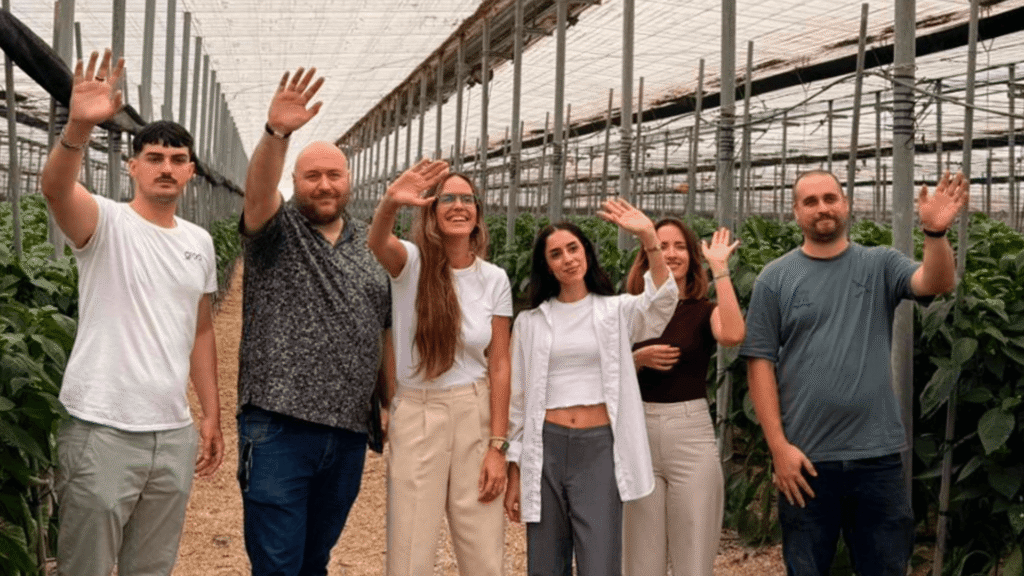
As intensive agriculture faces mounting pressure to improve productivity while reducing resource use, automation and data driven decision making are becoming essential tools for growers. Almería based agritech startup Grodi is positioning itself at the centre of this shift, having secured €2.5 million in new funding to expand its autonomous robotics and computer vision technology designed specifically for Mediterranean greenhouse farming.
Funding to accelerate growth
The investment round was led by Swanlaab Innvierte Agri FoodTech, with participation from Axon Desarrollo Andalucía and Innvierte, SICC del CDTI. The funding supports Grodi as it transitions from early deployment into a commercial scale up phase, responding to growing demand from growers and cooperatives seeking more precise and standardised crop data.
Founded in 2022, Grodi is building technology that addresses the realities of intensive horticulture, where crop density, environmental variability, and labour constraints make traditional monitoring methods increasingly inefficient.
Built for Mediterranean greenhouses
Grodi was founded in Almería by Samuel Ruíz, Natalia Gálvez, and Ana Molina, bringing together expertise across engineering, robotics, artificial intelligence, and agronomy. The company has focused its development on Mediterranean intensive agriculture, particularly greenhouse environments that require constant crop oversight but are often underserved by generic agri technology solutions.
By designing its systems around real world operational conditions, Grodi aims to give growers access to objective, continuous, and standardised data that reduces uncertainty and improves agronomic decision making.
VEGA 11 autonomous robot
At the centre of Grodi’s offering is VEGA 11, an autonomous robot designed to operate independently inside greenhouses. The robot navigates crop rows without human intervention and captures high resolution visual data across the full plant lifecycle.
Using advanced computer vision and machine learning models, VEGA 11 analyses plant growth, health indicators, and yield related variables. This allows growers to anticipate potential issues earlier, optimise agronomic practices, and estimate production volumes with a higher degree of accuracy.
From data capture to actionable insight
Grodi’s technology goes beyond robotics alone. Data collected by VEGA 11 is processed through the company’s digital platform, which centralises information in near real time and transforms raw visual inputs into actionable agronomic insights.
This integrated approach supports safer and more efficient operations by helping growers optimise inputs such as water and fertilisers while maintaining consistent production standards. The system is also designed to support cooperatives and seed companies that require comparable data across multiple sites.
Focus on practical impact
Grodi’s leadership emphasises that usability and day to day value remain core priorities. According to CEO Ana Molina, farmers need solutions that directly simplify production management rather than adding complexity.
She noted that the sector increasingly demands tools that reduce costs, improve resource efficiency, and standardise processes across operations. VEGA 11, she said, is already demonstrating how automation and computer vision can transform daily crop management in a tangible way.
Scaling deployment and expanding markets
With the new funding, Grodi will focus on industrialising the VEGA 11 robot to support larger scale deployments. The company also plans to strengthen its commercial presence across Spain’s main horticultural regions, where intensive greenhouse farming plays a critical economic role.
In parallel, Grodi is advancing its international expansion strategy, targeting markets facing similar productivity and sustainability challenges. The company is also continuing to expand its technology portfolio, developing additional products designed for real agricultural conditions.
As pressure grows on the agri food sector to produce more with fewer resources, Grodi is betting that autonomous robotics and computer vision will become essential infrastructure for the future of intensive agriculture.