
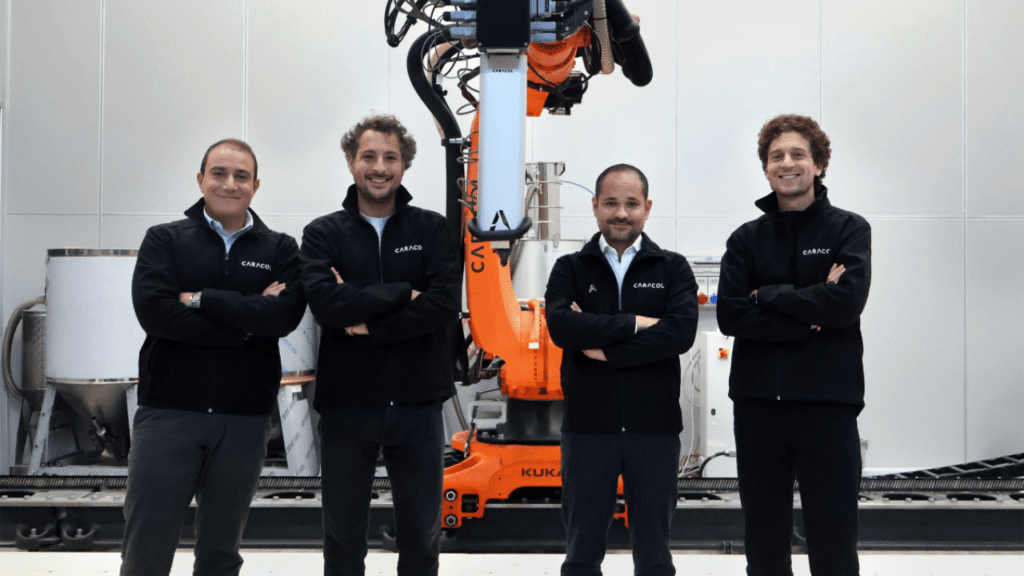
For decades, additive manufacturing, more commonly known as 3D printing, was largely associated with small prototypes, plastic components, and desktop machines producing objects measured in centimetres rather than metres. While the technology steadily expanded into industries such as aerospace, automotive, healthcare, and defence, scaling additive manufacturing for large industrial components remained one of the sector’s biggest unsolved challenges. Italian advanced manufacturing company Caracol is now attempting to change that by combining robotics, software, and automation into a new model for industrial scale production.
Founded by Francesco De Stefano alongside co founders Giovanni, Paolo, and Jacopo, Caracol specialises in Large Format Additive Manufacturing technology designed to produce large polymer, composite, and metal components at industrial scale. The company integrates robotic arms, advanced software systems, automation tools, and manufacturing engineering into connected production systems capable of manufacturing lightweight industrial structures and functional parts for sectors including aerospace, maritime, transportation, energy, and defence.
Breaking the “Box” of Traditional 3D Printing
According to De Stefano, additive manufacturing historically accepted the physical limitations of the printer itself as an unavoidable constraint. Traditional 3D printers generally operate on three axes inside fixed enclosed structures, limiting both scalability and geometric flexibility.
Caracol approached the problem differently by combining additive manufacturing with industrial robotics. Unlike conventional printers, industrial robotic arms operate across six axes, allowing significantly greater freedom of movement and enabling the production of much larger and more complex components.
The idea emerged around 2015 when De Stefano and his co founders recognised that additive manufacturing had strong potential but remained too limited in scale for industrial applications. Over the following years, the team focused on integrating robotics with additive manufacturing technologies in order to move beyond the limitations of traditional printer architectures.
Rather than commercialising the technology immediately, Caracol spent its first years operating as a service bureau. The company worked closely with aerospace, automotive, and maritime manufacturers to test materials, qualify applications, develop prototypes, and support certification processes before officially commercialising its systems in 2022.
Transforming Industrial Manufacturing
Caracol’s robotic manufacturing systems are now being used to produce large marine structures, industrial moulds, aerospace tooling, and functional industrial components directly from digital designs without relying on traditional mould based manufacturing methods.
In sectors such as maritime manufacturing, producing large composite parts traditionally involves months of preparation, including creating moulds, manually laminating materials, and performing extensive finishing work. Caracol’s additive manufacturing systems eliminate the need for mould creation entirely by manufacturing components layer by layer directly from digital files.
According to De Stefano, this can reduce lead times by more than half while also lowering production costs significantly. In one project with yacht manufacturer Ferretti Group, the company achieved cost reductions exceeding 30 percent.
The technology also dramatically reduces material waste. Traditional aerospace tooling processes often waste up to 70 to 80 percent of material during machining, while Caracol’s additive manufacturing systems reduce waste to below 5 percent. Components manufactured through the company’s systems are also significantly lighter, with some tooling applications weighing only one tenth of traditional alternatives.
Expanding Into Metal Manufacturing and Energy
Around two years ago, Caracol expanded into metal additive manufacturing, opening opportunities across energy, propulsion systems, industrial equipment, and nuclear related applications. The company is also exploring future manufacturing solutions designed for use in space environments.
Today, Caracol operates manufacturing facilities in both Europe and the United States, making it one of the few large format additive manufacturing companies with transatlantic production capabilities. De Stefano noted that the US market has become increasingly important, particularly across aerospace, defence, and industrial sectors where flexible localised manufacturing is gaining momentum.
Toward Autonomous Manufacturing Systems
Automation inside Caracol’s production systems has evolved rapidly since the company’s early days. While earlier systems required constant operator supervision, current platforms can now run autonomously for days with minimal intervention.
The company has developed its own software ecosystem through its Nexus platform, which aggregates manufacturing data across its global network. More recently, Caracol launched its ADOS AI platform, allowing systems to monitor production in real time, identify deviations, and automatically adjust manufacturing parameters without human input.
De Stefano said the company’s long term vision extends beyond individual autonomous machines toward globally connected manufacturing systems capable of continuously learning and improving together through shared data and centralised intelligence.