
Logibot is taking a hardware agnostic approach to warehouse automation, using software and artificial intelligence to help logistics companies deploy robots without being locked into one equipment supplier. The Belgian startup has raised €1.4 million to bring more robots into customer operations and expand its platform for labour intensive logistics tasks.
Funding and investor participation
The funding round was led by BeamBerlin, the startup studio of German family owned intralogistics group BEUMER. RDY Ventures, PMV and the BAN Business Angels network also participated.
The capital will support the rollout of Logibot’s first robots at logistics customers and the assembly of a second robot. Sensors for the new system are being mounted at the company’s facility in Zellik, Flemish Brabant.
Logibot currently has seven employees. Its early customers include logistics providers with workforces ranging from 8,000 to 21,000 employees, as well as one of the largest logistics and postal groups in the Nordic region. A Logibot supported robot is already operating in Denmark.
Tackling warehouse labour shortages
Warehouses, sorting centres and distribution hubs across Europe continue to face difficulties recruiting workers for repetitive and physically demanding jobs. These include sorting parcels, moving cages, loading vehicles and handling goods across warehouse floors.
Temporary staffing can increase labour costs, while high employee turnover creates additional expenses through repeated recruitment and training. Logibot’s proposition is to make robotic labour easier to introduce into existing facilities without requiring companies to redesign their entire operations.
The company’s official website describes Logibot as a hardware agnostic AI platform that helps logistics and industrial operators simulate, deploy, operate and continuously improve robotic labour in live warehouses. Its focus is on existing, space constrained facilities rather than newly built sites designed specifically for automation.
Software instead of a robot catalogue
Unlike traditional robotics manufacturers, Logibot does not build and sell one proprietary robot. Instead, it provides the software layer between warehouse operations and different types of robotic hardware.
The approach allows customers to select equipment according to the task. A simple robotic arm may be sufficient for parcel sorting or handling, meaning operators do not necessarily need a complex humanoid system for every application.
Logibot’s platform is designed to work with multiple robot manufacturers and hardware configurations. This reduces the risk of vendor lock in and gives customers the option to change equipment if a supplier no longer meets their requirements.
From simulation to live deployment
The platform covers the full automation process. It first analyses warehouse flows, operational constraints and performance requirements to identify suitable tasks. Those use cases can then be tested in a digital twin or simulated environment before physical deployment.
Once a robot and task have been selected, Logibot trains the system for the specific operating conditions. The software then integrates the robot into existing workflows and monitors its performance after deployment.
The company also uses cameras calibrated for individual applications, alongside remote monitoring and human teleoperation. This human in the loop approach allows operators to intervene when robots encounter unexpected situations or tasks that require additional supervision.
Building a temporary workforce of robots
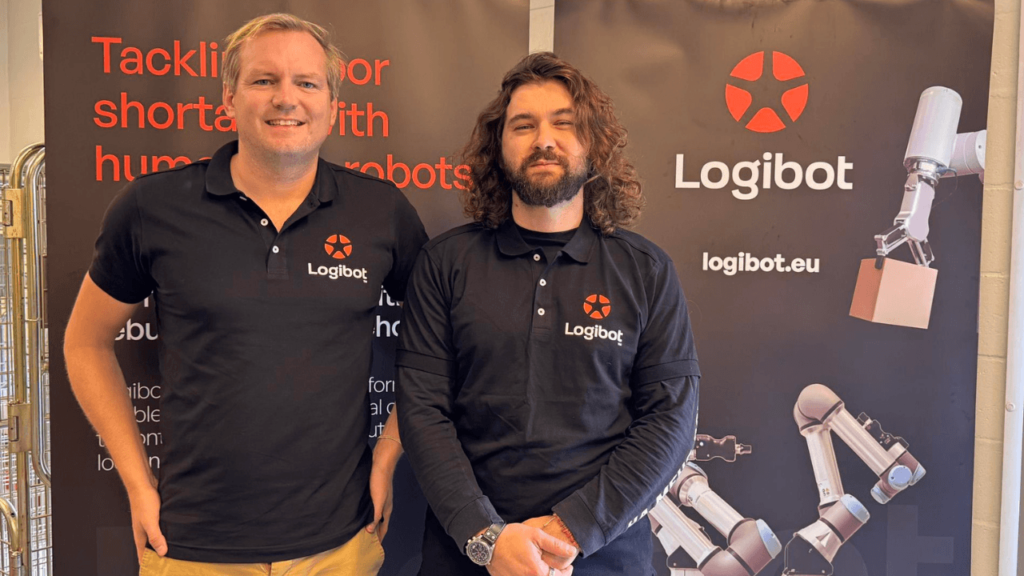
Logibot was founded by Louis Verspreeuwen and Salimzhan Gafurov. Verspreeuwen brings 12 years of experience in logistics and international trade, including work in China and Hong Kong. Gafurov, the company’s chief technology officer, holds two PhDs in robotics and AI. He previously led a team of 110 robotics engineers at a major ecommerce company and worked as CTO at robotaxi venture Verne.
Verspreeuwen says the company aims to become “the temp agency for robots”, providing robotic workers when warehouses need them without forcing customers into long term commitments to a single supplier.
The new funding will help Logibot move beyond early deployments, develop additional robotic systems and demonstrate that flexible, software managed automation can deliver measurable value in busy logistics environments.