
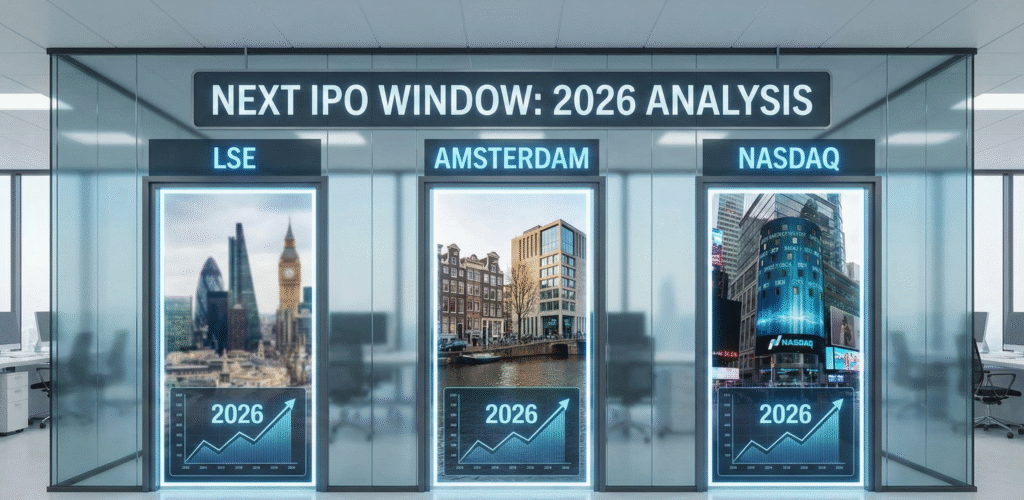
The concept of an “IPO Window” is often discussed in boardrooms as if it were a meteorological event. It is not. It is a function of liquidity depth, volatility indexes and institutional risk appetite. For the European tech CFO in 2026, the decision of where to list is no longer about patriotism or prestige. It is a calculation of regulatory arbitrage and the cost of capital.
We are seeing a divergence in the three primary venues available to European scale-ups. The London Stock Exchange, or LSE, has radically overhauled its plumbing to stop the brain drain. Euronext Amsterdam remains the safe harbour for steady governance. And NASDAQ continues to offer the siren song of maximum valuation, albeit with a heavy litigation tax.
The LSE Reform: A Structural Reset
The narrative that “London is dead” is empirically lazy. The Financial Conduct Authority has executed the most significant rewrite of the UK Listing Rules in decades.
The introduction of the Equity Shares (Commercial Companies) (ESCC) category has replaced the bifurcated Premium and Standard segments. For the tech founder, this is not just administrative cleanup. It is a game-changer.
- Removal of Class 1 Votes
Previously, a Premium listed company needed shareholder approval for significant transactions. This slowed M&A execution and put UK companies at a disadvantage compared to US peers, who could buy targets overnight. That friction is now gone. - Dual-Class Shares
The new rules finally normalise weighted voting rights. Founders can now list in London without losing control, which removes the primary structural reason for fleeing to New York. - The Stamp Duty Holiday
The recently implemented 3-year stamp duty exemption for new IPO shares has effectively lowered the cost of entry for institutional buyers.
Euronext Amsterdam: The Governance Safe Harbour
While London deregulates, Amsterdam doubles down on stability. It remains the venue of choice for deep tech and fintech assets that prioritise long-term holding bases over quarterly volatility.
- The Adyen Effect
Amsterdam has successfully cultivated a cluster of high-quality payments and infrastructure stocks. The valuation multiples for fintech assets here are structurally higher than in Paris or Frankfurt because the investor base understands payments’ unit economics. - Pan-European Access
Listing on Euronext offers a single entry point to a deep pool of continental pension fund capital that is mandated to invest in “EU Sovereign” assets. For companies betting on the EU AI Act as a moat, staying within the EU regulatory perimeter offers a compliance premium.
NASDAQ: The Premium and The Price
The valuation gap remains the elephant in the room. US tech stocks continue to trade at a 30% to 50% premium over their European counterparts. However, this premium is not free money. It is compensation for higher operating costs.
- The Litigation Tax
A NASDAQ listing exposes the issuer to the US class action ecosystem. The cost of Directors and Officers (D&O) insurance for a US-listed company is significantly higher than for a European equivalent. - The Scale Threshold
The “Death Zone” on NASDAQ has moved up. Companies with a market cap under $2 billion are now effectively ignored by US banks and analysts. Unless you can guarantee $10 million in daily trading volume, you will become a “zombie stock” in New York.
The Verdict: Where is your Liquidity?
Your specific liquidity profile drives the decision matrix for 2026 Founders. They must rigorously audit their operational readiness using our Manual for Exit Strategy: M&A vs IPO before engaging underwriters.
- Go to London if you are an asset of €500M to €2B with an aggressive M&A strategy. The new rules allow you to use your stock as acquisition currency without shareholder friction.
- Go to Amsterdam if you are a deep tech or infrastructure play looking for patient sovereign capital and EU regulatory alignment.
- Go NASDAQ only if you are a >$3B “category king” with the operational infrastructure to handle Sarbanes-Oxley and the desire to compete for US retail capital.
For many, the most brilliant move in 2026 is actually to delay. As we analysed in The Rise of GP-Led Secondaries in Europe, private markets are currently offering better liquidity terms than public markets for assets in the “middle class” of growth.
Until the valuation disconnect narrows, the “IPO Window” may simply be a door to higher volatility.