
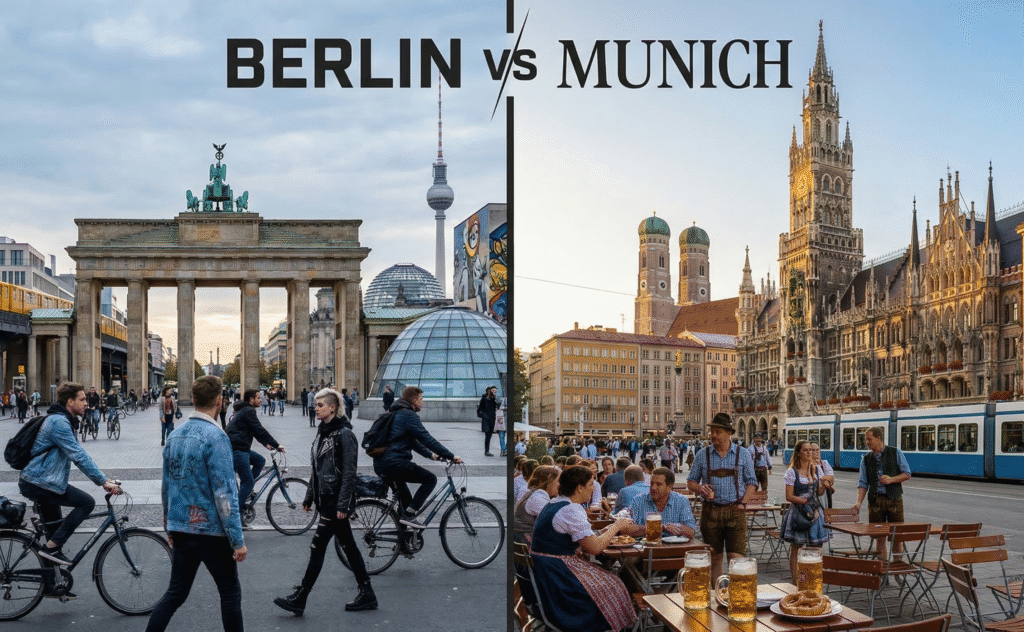
For the last decade, the European venture capital narrative was remarkably simple: if you wanted to build a billion-dollar technology company in Germany, you moved to Berlin. The capital monopolised early-stage funding, attracted the deepest international talent pools, and built the digital infrastructure for the continent.
However, as we analyse the finalised 2025 and early 2026 macroeconomic data, that singular narrative has officially fractured. A seismic shift in the geography—quietly referred to by institutional investors as the “Munich Flip”—has fundamentally rewritten the German venture ecosystem. We are no longer looking at a single dominant hub, but rather a highly specialised, dual-engine economy. Berlin continues to dominate software and transaction volume, but Munich has aggressively captured the massive, capital-intensive mega-rounds required to build physical sovereign infrastructure.
To understand where European limited partners are actually deploying their capital, we must tear down the aggregate national data and map the distinct DNA of these two rival ecosystems.
The 2026 Data: The Munich FlipVisualised
According to the latest EY Startup Barometer Germany, the German venture market experienced a massive rebound in 2025, securing €8.4 billion in total investment, a 19% year-over-year increase. Yet, beneath this national recovery lies a historic inversion of capital concentration.
For the first time, Bavaria has officially overtaken Berlin in total capital raised, securing nearly half of all German venture capital.
| Metric (2025/2026 Data) | Berlin | Munich (Bavaria) | Ecosystem Trajectory |
| Total VC Invested | €2.7 billion | €3.3 billion | Munich leads in total liquidity deployed. |
| Total Deal Volume | 218 deals | 148 deals | Berlin remains the undisputed volume engine. |
| Average Ticket Size | €12.3 million | €22.2 million | Munich commands a massive premium per round. |
| Graduation Rate (Seed to Series A) | 37% | ~28% | Berlin excels at early-stage survival. |
This data reveals a striking dichotomy. Berlin retains the highest deal volume, proving it remains the ultimate incubator for early-stage founders testing new concepts. However, Munich commands a drastically higher average ticket size. When a company in the south raises capital, it requires vastly more of it.
Munich: The Deep Tech and Defence Fortress
The €3.3 billion flooding into Bavaria is not funding consumer delivery apps or gamified crypto wallets. It is funding physical engineering. Munich has successfully positioned itself as the undisputed capital of European deep tech, defence, and industrial hardware.
The brutal CapEx requirements of physical engineering drive this ecosystem. You cannot build a satellite constellation or a nuclear fusion reactor with a €2 million seed round. These startups require massive, patient capital often sourced from the localised German Mittelstand and corporate venture arms that understand physical asset depreciation and decadal timelines.
Colossal industrial and defence rounds heavily skew the 2025 data:
- Helsing: The defence AI contractor secured a staggering €600 million in Series C funding, pushing its valuation to €12 billion.
- Isar Aerospace: The Munich-based space tech firm secured €150 million via convertible bonds to fuel sovereign European satellite launch capabilities.
- ITM Isotope Technologies: The Munich radiopharma giant secured €262.5 million in non-dilutive financing to scale its cancer therapeutics.
When international venture capitalists deploy capital in Munich, they are betting on strong intellectual property, deep academic moats built by institutions like TU Munich, and technologies critical to European national security.
Berlin: The CFO Stack and Transaction Engine
While Munich bends physics, Berlin codes the financial operating systems required to monetise it. The capital may have lost the crown for total funding volume, but it remains an absolute fortress for B2B SaaS, fintech, and digital infrastructure.
Berlin is the city of “Bits.” With over 1,600 VC-backed startups and a combined enterprise value of €169 billion, the city possesses an unparalleled commercial velocity. The ecosystem is uniquely efficient at helping startups navigate the notorious “Valley of Death,” with a remarkable 37% of seed-stage companies graduating to Series A funding.
Rather than chasing hardware, Berlin founders are aggressively building the European CFO Stack. They are leveraging generative AI not to write emails, but to automate complex compliance, payroll, and supply chain transaction layers across the EU. Berlin is home to massive commercial juggernauts like Trade Republic and a dense network of highly agile enterprise SaaS startups.
Furthermore, Berlin is rapidly establishing itself as Europe’s premier climate tech software hub, boasting over 340 startups in the vertical and capturing over €800 million in climate VC since 2024.
A Necessary Division of Labour
The “Munich Flip” does not signal the death of Berlin; it signals the maturation of the German economy. Europe can no longer afford to try to replicate Silicon Valley’s consumer software monopolies. It must play to its own sovereign strengths.
Germany has evolved into a highly efficient dual-engine machine. Berlin operates as the high-velocity transaction and software engine, boasting superior deal volume, rapid prototyping, and elite fintech infrastructure. Munich operates as the heavy industrial engine, capturing the massive, late-stage growth rounds required to build physical hardware, aerospace technology, and defence systems.
For institutional investors, the strategy is now explicitly geographically defined. You go to Berlin to scale the software and you go to Munich to build the machine.