
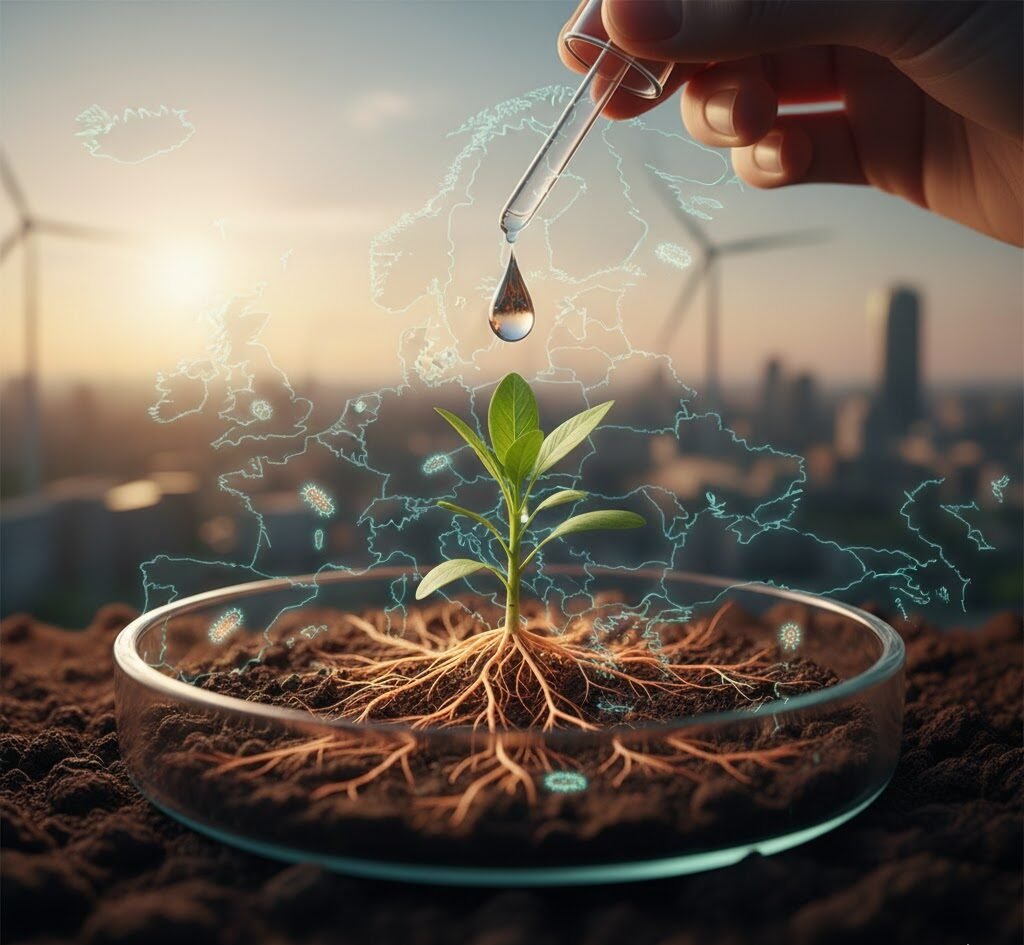
Europe just pushed a very public bet on its food future. Stéphane Séjourné, Executive Vice-President for Prosperity and Industrial Strategy, quoted that “Europe has long been a global leader in the life sciences economy. In today’s increasingly competitive world, the European Commission is driving new ambition for the sector through simplification, investment and a stronger single market,”. The Commission’s new Strategy for European Life Sciences earmarks a significant package of approximately €350 million aimed at accelerating biomass and precision fermentation, to scale sustainable food production and position Europe as a leader in life sciences by 2030. However, the leap from laboratory novelty to supermarket staple depends on three fragile threads, the regulation, scale-up infrastructure, and consumer trust, and each needs repair if fermentation is to underpin Europe’s food security.
What precision fermentation actually does and why it matters
Precision fermentation repurposes microbes as microscopic factories with the use of engineered yeasts, bacteria or fungi synthesise specific proteins, lipids or enzymes inside controlled bioreactors. Unlike broad biomass processes (think tempeh-style fermentation), precision fermentation produces target molecules that are identical or analogous to animal-derived ingredients from whey proteins to milk fats to cocoa alternatives, often with far lower land, water, and greenhouse-gas footprints. For a continent that imports large volumes of protein and commodity ingredients, the technology promises domestic, climate-resilient production that could reduce import exposure and buffer supply shocks. The FAO’s recent technical review underscores both the promise and the safety complexities of this approach.
Why Brussels is betting on fermentation
There are three tight, connected reasons the EU has put fermentation centre stage:
- Security & resilience. Precision fermentation can localise production of key ingredients (proteins, enzymes, fats) that are now imported or tied to fragile global supply chains.
- Climate and land use. Producing high-value proteins in bioreactors can help bypass land, water, and methane emissions associated with ruminant agriculture. The Commission explicitly links life sciences investment to green, circular goals.
- Industrial competitiveness. Europe aims to transform lab IP into manufacturing jobs and exportable products. The new strategy is as much an industrial policy as it is a food policy. The €350m commitment serves as a signalling device, using public money to attract private scale-ups.
Regulation, scale and trust
Two technical bottlenecks repeatedly surface in the field, scale economics and regulatory clarity.
Regulatory systems vary widely. The FAO synthesis found no single international definition of precision fermentation and urged competent authorities to harmonise safety frameworks, otherwise, firms will face fragmented market access and consumer confusion. In practice, this means companies must juggle safety dossiers, novel food pathways, and country-by-country approval timelines.
On the manufacturing side, achieving unit costs that enable ingredient buyers to adopt fermentation-made proteins at scale depends on titters, yields, and downstream separations. Startups argue that the commercial route is not just about price parity, but also about new functionality and novel ingredient forms that unlock product formats (such as clear protein drinks and designer emulsifiers) that incumbent ingredients can’t deliver. Stephan van Sint Fiet, CEO of Dutch precision-fermentation startup Vivici, puts it, “If we narrow the message only to ‘animal-free,’ we’re pigeonholing ourselves… these ingredients don’t just need to compete on cost; they can compete on functionality and enabling new product launches.”
Money, strategy and the missing administrative translation
The EU’s Horizon Europe program will play a significant role in funding precision fermentation. The program has allocated an initial €150 million to the sustainable bioeconomy, with an additional €200 million earmarked for 2026–27 to advance biomanufacturing and life sciences partnerships. This funding is designed to address a key challenge which is that many fermentation firms have viable strains and pilot data, but lack the collaborative funding pathways to industrialise their processes. But it’s important to note that public financing alone won’t be enough to bring precision fermentation to a commercial scale. Clearer regulatory pathways and faster authorisation processes are also needed. The Commission’s strategic agenda is a step in the right direction, but what firms need most is a predictable set of market rules.
Netherlands and the UK- testbeds of ambition
Two ecosystems are already moving faster than most. The Netherlands has invested in open-access scale-up facilities, injecting national capital to create pilot plants for cultivated meat and precision fermentation, so startups don’t have to shoulder crippling capital expenditures alone. That practical approach, which shares infrastructure that lets firms scale within Europe, is a template worth emulating. Meanwhile, the UK’s food regulator has been proactive in streamlining novel food assessments and recently published draft technical guidance, signalling an intention to move quickly on precision breeding and novel production routes. Those steps reduce friction for startups and make the UK an attractive market for early commercial launches. Variability in national approaches also risks fragmentation unless mutual recognition and EU-level guidance are established.
Regulation and food safety
Precision fermentation is not inherently unsafe, but it is novel enough to demand rigorous oversight. EFSA and other bodies have already updated guidance to clarify how novel microbial-derived ingredients should be assessed. The FAO report lays out practical safety assessments and case studies, recommending harmonised nomenclature, transparent process descriptions and risk-based controls, exactly the ingredients of a workable regulatory framework. For European startups, this means investing early in regulatory dossiers, traceability and process transparency. For regulators, it means striking a balance between precaution and a timetable that doesn’t stifle growth before it begins.
Commercial hurdles
Technically, precision fermentation can deliver quality; commercially, cost is a key factor. Startups must reduce costs across upstream fermentation, downstream processing, and purification. Shared pilot plants reduce unit economics, but commercial viability still requires cheap feedstocks (often agricultural byproducts), efficient purification tech and reliable offtake agreements from food companies. Even if price parity is years away, the EU’s funding and industry partnerships can shrink the gap if they prioritise industrial demonstration projects and feedstock circularity. Public procurement or incentive programs for climate-friendly ingredients could accelerate the early adoption of these ingredients.
Public perception
If the technology passes safety and price hurdles, public acceptance remains a wildcard. Precision fermentation is often misunderstood: the term “fermentation” evokes traditional foods for some, while “engineered microbes” evokes others. The FAO recommends transparent nomenclature and public-facing education campaigns; industry must pair that with sensory parity (taste/texture) and clear labelling. EU efforts to fund R&I aimed at improving taste and affordability are crucial, as consumers will choose cleaner ingredients only if the products taste good and are affordable. Strategic public communication, open science and co-creation with chefs and consumer groups will be critical levers.
What a workable roadmap looks like
Below are pragmatic, actionable items that combine policy and market realities and help turn Brussels’s €350m signal into durable capacity:
- Fast, harmonised approvals: a Europe-wide regulatory playbook for precision-fermented ingredients (aligned with FAO best practices) would significantly reduce market entry friction.
- Pilot-to-plant vouchers: conditional public financing that unlocks capital for plant engineering once a firm reaches pre-defined tech and market KPIs. This nudges grant winners to demonstrate industrial readiness.
- Industry partnerships: co-development deals between startups and large ingredient buyers (dairy, snacks, chocolate) to absorb offtake risk and accelerate formulation work.
- Consumer transparency campaign: fund independent safety and nutrition testing and communications so “fermented” does not become a misread label. The FAO flagged nomenclature confusion; clear language matters.
- Talent & regional hubs: invest in biomanufacturing clusters (fermentation foundries, analytical labs, training pipelines) spread across member states, so not all capacity concentrates in a few regions.
Conclusion
Precision fermentation is not a cure-all, but it is a powerful tool in Europe’s food security arsenal. It offers the potential for domestic production, lower emissions, and more resilient supply chains. The EU’s €350 million investment and Horizon’s allocations create a crucial opportunity to turn laboratory successes into commercial realities. The question is whether Europe will move quickly enough to harmonise rules, fund shared industrial infrastructure, and build public trust to make precision-fermentation-derived foods a reliable pillar of food security by 2030. If not, Europe risks losing control of its food future.