
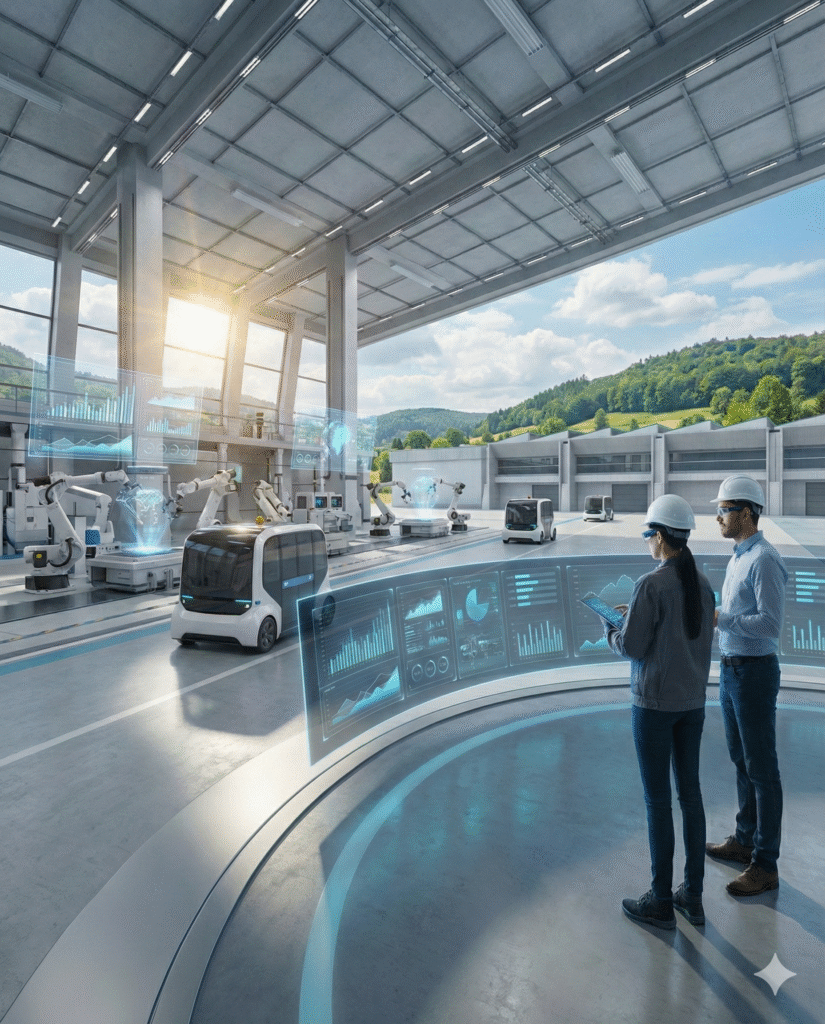
The European manufacturing sector stands at a definitive inflexion point in 2025. Long the bedrock of the continent’s economic stability, the industry is currently navigating a complex transition that extends far beyond simple technological upgrades. We are witnessing the maturation of Industry 4.0 and the simultaneous emergence of Industry 5.0. This new paradigm shifts the focus from pure techno-centric efficiency to a broader mandate encompassing resilience, sustainability, and human-centricity. This transition is occurring alongside acute external pressures, including the lingering disruptions of the post-pandemic era and geopolitical instability, which have exposed the fragility of lean supply chains. Furthermore, Europe faces a unique demographic challenge known as the “silver wave,” where a massive cohort of skilled workers is retiring, taking with them decades of institutional knowledge and expertise.
In this landscape, Artificial Intelligence (AI) has graduated from experimental pilots to the central nervous system of the modern factory. The adoption of AI is no longer just about shaving percentage points off production costs but is a strategic imperative for survival. It is the mechanism by which European manufacturers aim to maintain global leadership in high-value production while adhering to strict regulatory standards.
A Shift from Industry 4.0 to Industry 5.0
For the past decade, the dominant narrative has been Industry 4.0, which has focused extensively on digitising manufacturing to create “smart factories” capable of autonomous decision-making. The primary metrics were productivity and competitiveness, often viewing technology as the driver and the workforce as a cost factor to be optimised. However, the limitations of this approach have become evident. The relentless pursuit of efficiency often came at the cost of resilience, and when global supply chains fractured, brittle systems failed to withstand the pressure.
Industry 5.0 has emerged to repurpose these technologies rather than replace them. It represents a value-driven shift where technology serves societal goals. Unlike its predecessor, Industry 5.0 emphasises resilience, sustainability, and human-centricity. It views the human worker not as a liability to be automated away, but as an investment to be empowered. This shift is also driven by the pragmatic need to capture the tacit knowledge of retiring experts. Manufacturers are now deploying AI-driven “copilots” that ingest technical manuals and maintenance logs, allowing younger workers to access expert-level guidance instantly, effectively democratising institutional memory.
The Economic Velocity of AI Adoption
The speed of AI diffusion in the European industrial sector is surpassing that of previous technological waves. Statistics indicate that adoption is happening at a breakneck pace, with the “Europe AI in Manufacturing Market” valued at approximately USD 9.57 billion and projected to grow at a Compound Annual Growth Rate (CAGR) of over 34% through 2032. This explosive uptake is fueled by the convergence of maturing technologies, such as Machine Learning and Computer Vision, with robust industrial infrastructure. Investment capital has followed this trajectory, with “Apply AI” startups in the EU seeing their combined enterprise value soar to €161 billion, a 16-fold increase over the past decade.
Despite these high adoption rates, the productivity picture is nuanced. While individual AI-forward companies see significant labour productivity growth, macroeconomic gains across Europe are initially modest due to regulatory friction and integration lags. Highly regulated industries and those with legacy infrastructure face steeper challenges than “born-digital” competitors, yet the momentum remains undeniable as companies race to integrate these tools to stay competitive.
The Architecture of the Smart Factory
The smart factory of 2025 is characterised by connectivity and the concept of the “Industrial Metaverse.” Because the sheer volume of data generated by modern machines renders traditional cloud-only architectures impractical, manufacturers are turning to Edge Computing. By processing data locally, they achieve the near-zero latency required for real-time decisions. This is enabled by Industrial 5G, as seen in Schneider Electric’s Le Vaudreuil factory in France. There, a private 5G network supports Augmented Reality (AR) applications that overlay real-time machine data onto the physical world, enabling technicians to “see” inside machines without needing to open them.
Digital Twins have also evolved from static 3D models to dynamic simulations. Northvolt, the Swedish battery manufacturer, utilises a “Cloud Factory Module” where every machine is mapped to the cloud, creating a complete digital replica of their gigafactory. This allows engineers to flag nonconformities in real-time. Similarly, the Renault Group has launched an “Industrial Metaverse” that connects thousands of pieces of equipment to simulate supply shortages or energy spikes before they occur, resulting in projected savings of hundreds of millions of dollars.
Predictive Maintenance
Among all AI applications, Predictive Maintenance (PdM) stands out as the most mature and economically impactful. It represents a fundamental shift from “run-to-failure” or scheduled maintenance to a condition-based approach. By using neural networks to detect non-linear patterns of degradation, PdM allows service to be performed only when necessary.
The economic benefits are substantial. Research indicates that implementing predictive maintenance can reduce overall maintenance costs by 18% to 25% and cut unplanned downtime by up to 50%. Furthermore, it can extend the lifespan of assets by 20% to 40% and significantly reduce defect rates. In the automotive sector, for instance, a single implementation on a stamping press resulted in $500,000 in savings for a manufacturer, avoiding repairs and downtime.
AI in Action in Europe
Leading European manufacturers are proving these concepts in the field. BMW is at the forefront of leveraging AI to revolutionise quality control processes. At their Regensburg plant, an AI monitoring system analyses conveyor technology to detect anomalies, such as struggling motors, thereby avoiding approximately 500 minutes of assembly disruption annually. In their body shops, AI-powered computer vision guides robots to weld stud frames with precision, reducing defect rates and saving over $1 million annually.
In the aerospace sector, Airbus utilises its Skywise platform to connect over 12,000 aircraft. By ingesting terabytes of operational data, the platform allows airlines to predict component failures. EasyJet, for example, utilised Skywise to prevent nearly 80 cancellations in just two months by addressing system alerts before grounding aircraft.
Danfoss, the Danish engineering giant, illustrates how legacy companies can pivot. At their Wuqing factory, they implemented innovative technologies that increased employee productivity by 30% and reduced scrap costs by 20%. In Italy, they introduced a digital workforce management system to optimise shift planning based on worker skills and ergonomics, directly contributing to employee well-being.
Navigating the Regulatory Fortress
Europe’s approach to AI is distinctly rules-based, aiming to strike a balance between innovation and fundamental rights. The EU AI Act classifies many manufacturing AI applications as “high-risk,” requiring conformity assessments and human oversight. While this imposes a compliance burden, it also offers a strategic advantage by allowing European manufacturers to market their systems as “Trustworthy AI,” a differentiator in a global market wary of opaque algorithms.
Simultaneously, manufacturers must navigate GDPR when digitising their workforce. Privacy-enhancing technologies are being adopted to monitor processes rather than individuals, ensuring compliance while still gathering necessary data. Cybersecurity is another critical front as factories connect to the internet, face threats from ransomware and state-aligned hacktivism. The ENISA Threat Landscape 2025 report emphasises the importance of adopting “Zero Trust” architectures to safeguard these interconnected industrial environments.
The Workforce and the Twin Transition
Contrary to fears of mass unemployment, the reality in 2025 is labour scarcity. The digital skills gap remains a significant hurdle, with only about 55% of adults possessing basic digital skills. To combat this, companies are investing heavily in upskilling their employees. Initiatives like the EIT “Deep Tech Talent” aim to skill one million Europeans, while companies like Renault are training thousands of employees to transition from data gatherers to data analysts. AI is acting as a force multiplier, augmenting human capabilities rather than replacing them.
Ultimately, AI is the linchpin of the “Twin Transition”, a combination of digital and green. AI systems are optimising energy usage by scheduling production during periods of peak renewable generation and low cost. They are also enabling the circular economy by extending asset lifespans through predictive maintenance. However, the environmental cost of computing power itself is a growing concern, pushing manufacturers to prioritise “Green AI” and energy-efficient data centres to ensure their digital solutions are genuinely sustainable.