
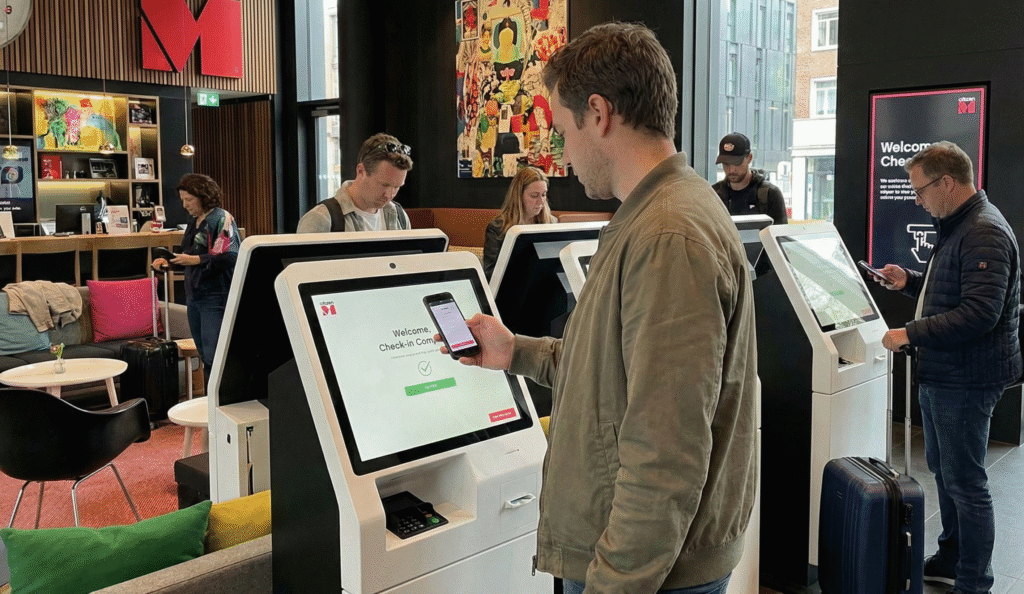
The CitizenM Digital Check-in Experience serves as the definitive manifesto for a brand that decided to terminate a century of administrative boredom. While the rest of the hospitality world remains shackled to the physical front desk, the visionaries at CitizenM recognised that traditional lobbies functioned as barriers rather than gateways. They chose to build a hotel that operates with the velocity of a high-performance software platform where every interaction is a calculated strike against friction. By engineering a seamless digital stack, the company has compressed the arrival process to less than 1 minute and transformed staff from administrative clerks into elite curators of the guest experience. This deep dive dissects the technical architecture and the uncompromising logic that make this transformation the gold standard for modern travel.
The Strategic Death of the Traditional Reception Desk
The primary motivation for the CitizenM Digital Check-in Experience was the profound realisation that the modern traveller values time above every other luxury. Traditional high-end hotels often equate slow service with exclusivity, but the contemporary business nomad views a ten-minute wait in a lobby as a fundamental design failure.
From an operational standpoint, the legacy gatekeeping model is remarkably inefficient. In a standard hotel environment, nearly 40% of front-of-house labour is wasted on repetitive data entry and passport verification. This is a massive drain on human capital that contributes nothing to the guest’s actual comfort. By automating these rigid tasks, CitizenM has achieved a staff-to-guest ratio that is 80% more efficient than the industry average. This allows the firm to invest more heavily in prime urban locations and premium room features while maintaining accessible pricing.
Architecting a Sovereign Cloud Ecosystem for Global Hospitality
The technical secret behind the CitizenM Digital Check-in Experience lies in its total rejection of fragmented legacy software. Most established hotel groups are trapped in a labyrinth of disconnected systems that refuse to communicate with one another. They might use one provider for their website, another for their property management, and a third for their electronic door lock, which creates a data silo at every turn.
CitizenM solved this structural crisis by building on a cloud native foundation. They were early adopters of Mews, a revolutionary Property Management System that operates under an API-first philosophy. This ensures that every component of the hotel, from the housekeeping tablet to the self-service kiosk, is connected to a single source of truth in real time. When a guest updates their profile in the mobile app, the information is instantly synchronised with every property in the global portfolio. This level of technical integration is as sophisticated as the sovereign stacks we explored in our guide to Building AI Without US Cloud Giants. It ensures that the digital perimeter is fortified and the data flow remains uninterrupted.
Engineering the Precision of the Sixty-Second Arrival
Understanding the mechanics of the CitizenM Digital Check-in Experience reveals a meticulous orchestration of hardware and software that begins long before the traveller arrives at the property.
The journey starts with the Pre Arrival sequence via the mobile app. This interface empowers the guest to scan their passport and provide secure payment details in their own time, effectively completing the heavy administrative work before they ever leave their home.
The physical component of the arrival involves intuitive kiosks provided by the Shiji Group. Unlike the clunky, slow terminals found in traditional business hotels, these units are sleek and responsive. A guest simply scans a QR code from their smartphone, and the kiosk dispenses an RFID room key in seconds. For those who prefer a purely digital route, the app uses Near Field Communication and Bluetooth Low Energy to turn the smartphone into a secure, encrypted key. By securing the digital perimeter, the hotel provides absolute peace of mind alongside unmatched convenience.
Quantifying the Industrial Power of Frictionless Systems
The success of the CitizenM Digital Check-in Experience is not merely a matter of brand opinion; clear, compelling industry data substantiate it.
Statistics indicate that over 90% of guests choose digital check-in options over any form of manual intervention. The average check-in time across the global portfolio is currently 45 seconds, nearly 10 times faster than the industry average. This radical efficiency has allowed the brand to reduce its front-of-house headcount by 50% while simultaneously achieving some of the highest guest satisfaction scores in the market.
Furthermore, the data harvested through this digital journey enables unprecedented levels of personalisation. The system tracks over fifty distinct guest preferences ranging from specific lighting temperatures to the exact time a guest typically requests extra pillows. This intelligence allows the hotel to pre-set rooms for returning visitors, which has driven a repeat booking rate that is 40% higher than the market standard. This strategic use of data aligns with the rigorous accountability we see in Sustainable Tourism Metrics, where every data point is used to drive performance and environmental integrity.
The Philosophical Shift from Clerk to Experience Curator
A standard critique of automation is the fear that it removes the soul of hospitality, but our analysis suggests that the CitizenM Digital Check-in Experience does the exact opposite. By removing the computer screen that traditionally serves as a wall between guests and staff, the brand has enabled more genuine human connections.
The employees, known as Ambassadors, are free to roam the lobby and interact with guests as equals. They act as local guides and baristas, and problem solvers rather than data entry clerks. This is the ultimate opinion of this case study. Automation is not about replacing people but about empowering them to do what they do best. When technology handles the repetitive, boring parts of the job, humans are free to add warmth and personality. This approach is the blueprint for the future of service industries, aiming for a perfect balance of high-tech and high-touch.
Conclusion
The CitizenM Digital Check-in Experience has redefined the boundaries of possibility within the global hospitality sector. By combining a cloud native PMS with intuitive hardware and a powerful mobile app, the brand has created a guest journey that is truly seamless and immune to the delays of the past. The statistics show that modern travellers are eager to embrace a faster, more personalised way of staying. As technology continues to evolve into the realms of biometrics and generative AI, CitizenM’s work will remain the primary reference point for any brand looking to compete in the digital age. They have proved that the best technology is the kind that disappears into the background, leaving only a perfect experience behind. The future of the hotel is no longer a physical desk but a digital symphony that starts the moment a guest decides to travel.