
Artificial intelligence has made remarkable progress in recent years, yet one major limitation continues to slow its adoption across complex industries. Most advanced AI models require enormous datasets and frequent retraining whenever conditions, environments, or data change, making deployment expensive and difficult to scale. As organisations increasingly seek AI systems that can adapt quickly to new situations without repeated training cycles, researchers are exploring entirely new approaches to machine intelligence. German startup kausable is among the companies pioneering this next generation of AI, and it has now secured fresh funding to accelerate the development of its reasoning first frontier models.
kausable has raised €12 million in a seed funding round led by UVC Partners and Entourage, with follow on participation from HTGF and Mätch VC.
The company also attracted support from a broad group of angel investors representing leading organisations across artificial intelligence, research, and enterprise technology.
The investment will help expand the company’s research team while accelerating development of its frontier AI platform and commercial pilot projects.
Building a New Generation of AI
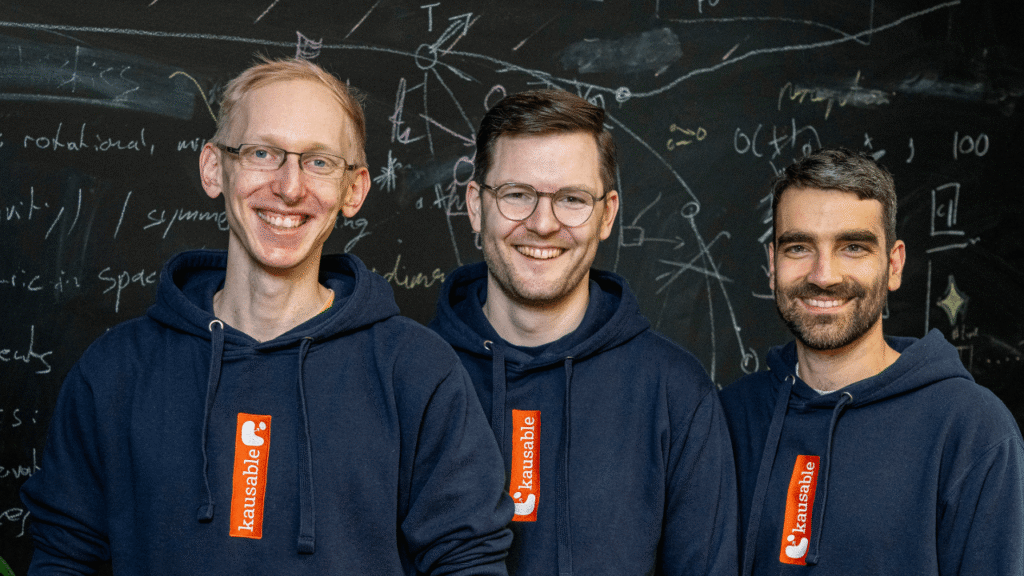
Founded in 2025 by Johannes Haux, Dr Benjamin Herdeanu, and Gregor Ramien, kausable emerged from research conducted at Heidelberg University.
The founders combine academic expertise with experience across technology startups, cybersecurity, and highly regulated industries.
The company focuses on developing reasoning first artificial intelligence that adapts to changing situations without requiring repeated model retraining.
Its broader vision is to build a foundational intelligence layer capable of supporting future AI systems across multiple industries.
This approach differs significantly from conventional foundation models that depend heavily on continuously expanding datasets.
Teaching AI to Understand Cause and Effect
At the centre of kausable’s technology is a reasoning architecture based on causal understanding rather than memorisation.
Instead of repeatedly updating model parameters whenever new information becomes available, the company’s AI learns underlying cause and effect relationships that allow knowledge to transfer across different environments.
This enables the system to learn new tasks using only a small number of examples.
The company believes this approach more closely resembles how humans acquire new skills by applying existing knowledge rather than starting from the beginning each time conditions change.
As a result, the technology aims to reduce both development costs and computational requirements.
Learning Through Synthetic Data
Unlike many AI developers that depend primarily on vast collections of real world data, kausable trains its models using synthetic causal datasets.
These simulated environments teach the AI how complex systems behave before it is applied to practical business applications.
The company believes this method offers several advantages, including improved data efficiency, stronger privacy protection, and greater control over model behaviour.
Rather than requiring enormous quantities of customer information, the platform can adapt rapidly using only limited additional evidence from real world deployments.
This allows organisations to introduce AI into environments where data availability may be limited.
Applications Across Critical Industries
One of the company’s early demonstrations is TipPFN, a forecasting model designed to predict critical transitions within complex dynamic systems.
The technology has demonstrated potential across healthcare, energy, environmental monitoring, and infrastructure by identifying tipping points before disruptive events occur.
Beyond forecasting, kausable sees significant opportunities in robotics, industrial automation, healthcare, and demand prediction, where AI systems must continually adapt to changing operating conditions.
The company is now working closely with early customers while preparing additional commercial pilot programmes.
Advancing Europe’s Frontier AI Ecosystem
The latest funding comes as Europe continues investing in sovereign artificial intelligence capabilities and advanced frontier research.
kausable plans to expand its nine person team while accelerating development of its rapid learning AI models.
The company also intends to strengthen collaboration between research and commercial deployment as it transitions from an academic research focused organisation toward broader industrial adoption.
With fresh funding, a growing research portfolio, and increasing industry interest, kausable is positioning itself among Europe’s emerging frontier AI companies. By focusing on causal reasoning instead of continuous retraining, the company aims to build more adaptable, efficient, and sustainable artificial intelligence capable of supporting the next generation of industrial, scientific, and commercial applications.