
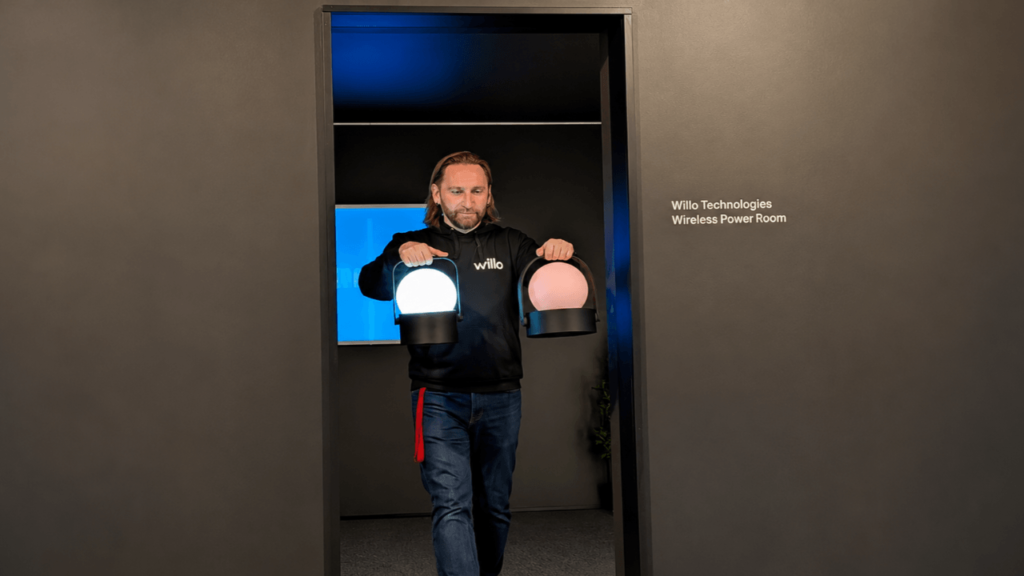
Finnish deeptech startup Willo Technologies is developing a wireless power system that could change how robots, industrial equipment and everyday electronics receive electricity. Instead of relying on charging pads, cables or precise alignment, its technology creates three dimensional power zones that allow multiple devices to draw electricity through the air, even while moving.
The Aalto University spinout is pursuing a vision in which robots can recharge without returning to a docking station and electronic devices can receive power simply by entering a room. At Slush in Helsinki, co founders Harri Santamala and Nam Ha Van demonstrated how the technology could bring that vision closer to reality.
Moving Beyond Conventional Wireless Charging
Most wireless charging systems available today rely on inductive or resonant technology, requiring devices to be placed on charging pads or positioned within a specific range and orientation.
Willo is attempting to remove these restrictions by transmitting electrical power through a three dimensional space. Its technology is designed to power several devices simultaneously, regardless of their orientation, movement or whether obstacles interrupt a direct line of sight.
The company calls this concept a three dimensional power zone. It has spent more than a decade building the underlying technology, bringing together academic research and hardware engineering experience from companies including Oura, Nokia and Microsoft.
One of the biggest challenges is maintaining stable electricity delivery as devices enter, leave or move around the power zone. Each device can have different energy requirements, potentially affecting the behaviour of the wider system.
Willo is developing its technology to manage these changing conditions while maintaining reliable power transmission.
Two Demonstrations, One Wireless Power Vision
At Slush, Willo showcased two applications of its technology: PowerBubble and a wireless room.
PowerBubble demonstrated a power field capable of supplying electricity to drones and robotic trucks without conventional charging infrastructure. The wireless room, meanwhile, showed how lamps could operate inside a space where power was transmitted without direct electrical connections.
Co-founder and CTO Nam Ha Van, explained that robotics offers a particularly promising starting point. Many industrial robots repeatedly return to the same operating areas, making it possible to create dedicated power zones that support continuous operations.
The company currently operates at 6.78 MHz, within the internationally designated industrial, scientific and medical frequency band. Its hub based technology has reached Technology Readiness Level 5, indicating validation in a relevant environment.
Robotics First, Consumer Electronics Later
Although the prospect of charging smartphones and laptops anywhere in a room is compelling, Willo is prioritising robotics and industrial automation for its initial commercial deployments.
The company is working with robotics original equipment manufacturers and hardware manufacturers to develop pilot projects. It estimates that commercial rollouts could begin within 18 to 24 months, depending on customer requirements and the capabilities of its current technology.
Consumer electronics presents a much larger potential market, but entering it requires partnerships with major device manufacturers. These companies would need to integrate compatible receivers into their products before consumers could benefit from room wide wireless charging.
Willo believes demonstrating the technology in industrial environments will help establish its capabilities and build confidence among potential partners.
A Research Partnership with Japan
In September 2026, Willo signed a 12 month joint research agreement with Japan’s Chiba University to address one of the most important technical challenges facing its technology: maintaining stable power delivery as devices move and their energy requirements change.
The research will involve Professor Hiroo Sekiya and his team, whose expertise includes high frequency power conversion and wireless power transfer.
The partnership also provides access to expertise in a country with strong industrial robotics, precision equipment and sensor industries, where eliminating cables and connectors could create meaningful operational advantages.
Building Towards Commercial Scale
Willo currently has a seven person team and is focused on strengthening its technical capabilities before expanding significantly. The startup believes having specialised engineering talent is more important than growing its workforce too quickly.
The company previously secured €2.9 million in funding to commercialise its technology and made its public debut at CES 2026, where it received CNET’s Best of CES award.
Its longer term ambition goes beyond improving charging convenience. By removing physical connections and alignment requirements, Willo wants to give manufacturers greater freedom to design robots, machines and electronic devices.
If the technology reaches commercial scale, electricity could become something devices access automatically from their surroundings, rather than something they receive through a cable or charging pad.
Editorial note: The supplied material did not specify the latest funding amount or the full investor list, so these have not been added. The interview quotes have also been paraphrased in places rather than attributed to an unidentified speaker.