
Some of the most critical industrial components, from rocket engines to gas turbines, hide their most dangerous defects deep beneath layers of dense metal. Detecting those flaws without dismantling expensive equipment remains a major challenge for manufacturers. Hamburg based deeptech startup MuRay is developing a new imaging approach that uses controlled muon beams to inspect dense materials, and it has secured €7.1 million in funding to advance the technology towards commercial use.
Investors Back MuRay’s Imaging Technology
MuRay’s financing comprises a €3.5 million private investment round and €3.6 million in non dilutive public funding. The private round was led by First Momentum Ventures and co led by Caelora, a wholly owned subsidiary of Marvel Fusion.
Other participants include Superangel, Mätch VC, Arcas VC and Tiny VC, alongside existing investor Nordic Science Investments. Public support includes funding from the European Union’s Horizon Europe programme.
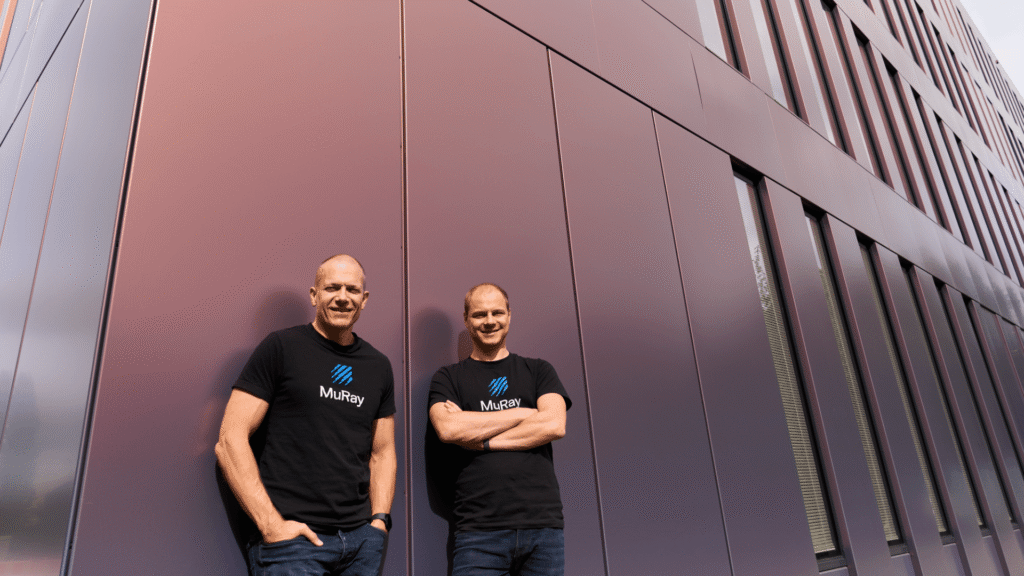
Founded by Dr Andi Hektor and Dr Kristjan Põder, who serve as co CEOs, MuRay aims to develop imaging systems that help industrial customers inspect large, dense and complex components more effectively.
The funding will support further technology development, industrial partnerships and preparations for commercial deployment.
Why Conventional Inspection Methods Fall Short
Manufacturers use X ray imaging and other non destructive testing techniques to identify internal cracks, structural weaknesses and manufacturing defects without damaging components. However, conventional X rays can struggle to penetrate particularly thick or dense materials, limiting their effectiveness in some industrial applications.
This creates challenges for industries producing complex components, including 3D printed rocket engines, gas turbines and aerospace equipment. Undetected defects can compromise safety, increase maintenance costs and force manufacturers to keep equipment out of service while inspections are completed.
MuRay is developing Active Muon Imaging to address these limitations. Muons are subatomic particles that can penetrate substantial amounts of matter, making them useful for examining structures that are difficult to inspect using conventional techniques.
Turning Muons Into High Resolution Images
MuRay’s technology uses controlled muon beams to produce three dimensional images of the internal structure of dense components. The system is designed to identify variations in material composition and density, helping manufacturers locate potential defects within metals, ceramics and composite materials.
According to the company, the technology could enable inspections to be completed within minutes rather than hours in suitable applications. It also aims to operate at a substantially lower radiation dose than conventional X ray methods.
The potential advantage is particularly significant for safety critical components, where manufacturers need reliable inspection results without dismantling equipment or interrupting production for extended periods.
Applications Across Aerospace and Energy
MuRay is initially focusing on industrial quality assurance, with potential applications across space, aerospace, defence and energy.
Reusable rocket engines and jet engines are particularly relevant because their components must withstand demanding operating conditions. More effective inspection could help manufacturers identify defects earlier and potentially shorten maintenance cycles.
The company is collaborating with the German Space Agency at DLR on modelling the inspection of a rocket engine. Following this work, MuRay plans to conduct its first real world assessment in 2027.
Beyond industrial manufacturing, the company is exploring potential uses in cargo security, nuclear material detection, radioactive waste monitoring and the inspection of large structures such as bridges and buildings.
Commercial Launch Planned for 2027
MuRay plans to introduce its first imaging service for industrial customers in 2027, using its imaging system alongside DESY’s existing electron beam infrastructure in Hamburg.
The company aims to follow this with its first full scale system incorporating a laser driven accelerator in 2029. It is also developing a mobile imaging system approximately the size of a shipping container, which could allow inspections to take place directly at industrial sites.
With €7.1 million in funding, MuRay is working to move its technology from development towards industrial deployment. Its success will depend on demonstrating reliable performance in real world conditions, but the company believes muon imaging could offer manufacturers a new way to inspect components that conventional methods struggle to penetrate.