
What if teaching a robot a new job were as simple as showing it how to do the task once? London based robotics startup Machenta is working to make that possibility a reality with an artificial intelligence model designed to help robots learn physical skills quickly. Emerging from stealth, the company has raised $40 million in a seed funding round, which it describes as a record for a UK robotics startup, to scale its technology and expand its team.
Record Funding for UK Robotics
The $40 million seed round was co-led by venture capital firms Creandum and Union Square Ventures. The investment will help Machenta advance its robot learning technology, increase its computing capacity and recruit additional specialists.
Founded by Edward Johns, a professor of robot learning at Imperial College London, and his former PhD student Vitalis Vosylius, Machenta builds on years of academic research into how machines can learn new physical tasks with greater speed and flexibility.
The company is developing a foundation model designed to help robots adapt to unfamiliar tasks without requiring extensive task specific training. Its ambition is to make robots easier to teach, potentially expanding their usefulness in industrial environments and everyday settings.
Learning From Just One Demonstration
Traditional robot training can require hundreds or thousands of demonstrations before a machine can reliably perform a new task. Collecting examples, training models and testing performance can take days or weeks, making it expensive to introduce robots to new activities.
Machenta aims to change this process through what it calls Instant Robot Learning. Its model is designed to observe a demonstration and then guide a robot through the task without additional training for that specific activity.
Potential applications include packaging products, assembling components, organising objects and carrying out routine physical work.
The company describes this approach as the physical equivalent of vibe coding, where people can communicate what they want to create without needing to understand all the underlying technical processes. In Machenta’s vision, teaching a robot could become as intuitive as demonstrating a task to another person.
AI Trained Entirely in Simulation
One of Machenta’s key differentiators is its approach to training data. Rather than relying on large collections of real world demonstrations, the startup says it trains its AI model entirely in simulated environments.
These computer generated worlds allow the system to learn about physical interactions and task variations without requiring the same level of real world data collection used by many conventional robotics approaches.
According to the company, this simulation first strategy could allow its model to improve through greater computing power and increasingly diverse simulated experiences.
After pretraining, the model is designed to use a real demonstration to adapt to a new task. Machenta says this approach could reduce the time and expense associated with teaching robots new skills.
However, the technology remains under development, and its ability to handle complex tasks reliably across different real world environments will be important to its future adoption.
Six Years of Research Behind the Startup
Machenta’s work began approximately six years ago at Imperial College London. Johns focused on a fundamental question: could robots learn new physical skills as quickly as humans?
Humans can often learn an unfamiliar task after watching someone perform it once. Robots, by comparison, frequently need repeated demonstrations and extensive training before achieving similar flexibility.
Johns believes intelligence should be measured not only by what a machine can already do, but also by how quickly it can learn something new. Machenta’s technology is built around this principle.
Expanding Its London Team
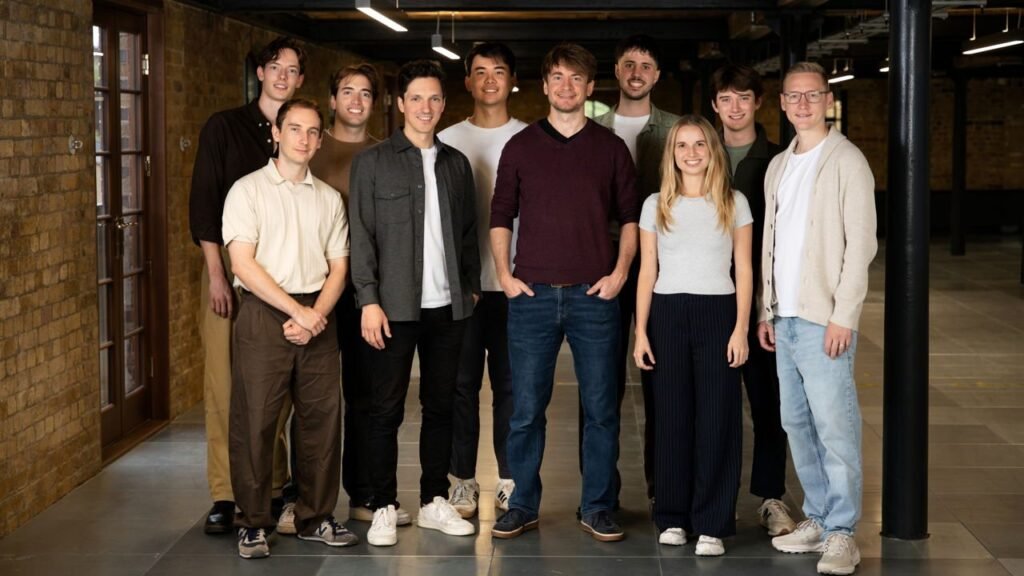
The startup currently has a team of around a dozen people working from its base in King’s Cross, London. The new funding will support further recruitment and the development of its AI model.
As businesses explore automation across manufacturing, logistics and other sectors, systems that can adapt quickly to changing tasks could become increasingly valuable.
Machenta’s next challenge is to demonstrate that its simulation trained model can deliver reliable results across a broad range of physical activities. If successful, its approach could help make robots more flexible, reduce the cost of retraining and bring adaptable automation to a wider range of workplaces.