
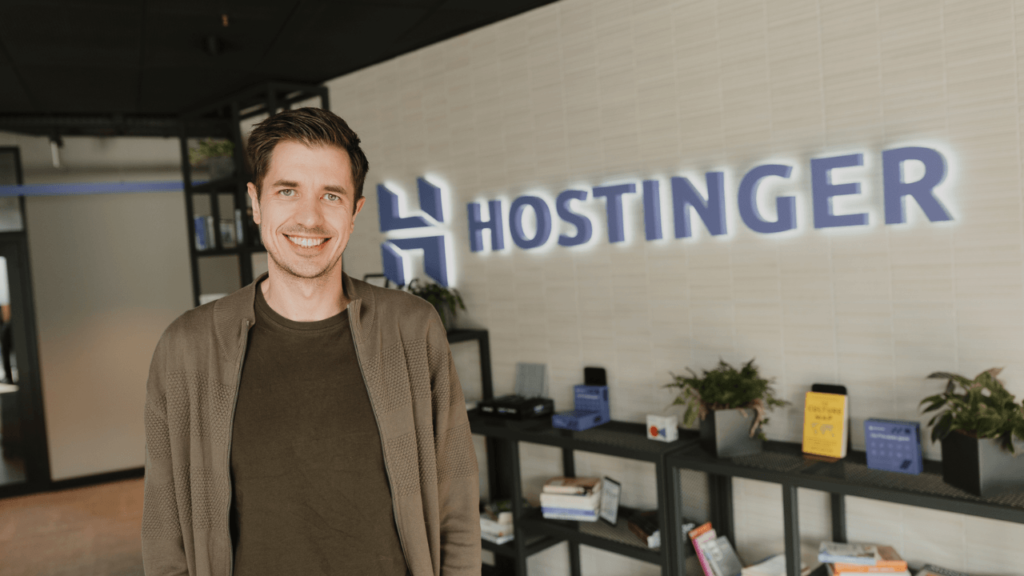
Building a website once required coding skills, technical knowledge and considerable time. Today, artificial intelligence is changing that equation, allowing people to create websites, digital tools and software products with far less expertise. For Lithuanian technology company Hostinger, the next challenge is helping those users turn their ideas into sustainable businesses.
Under CEO Giedrius Zakaitis, Hostinger is evolving beyond traditional web hosting into an AI powered platform designed to help entrepreneurs build, launch and manage online ventures.
From Hosting Websites to Running Businesses
Hostinger originally helped customers put websites online by simplifying the technical processes behind hosting. As tools such as one click WordPress installation became commonplace, the company increasingly focused on making complex technology accessible to people without technical backgrounds.
Zakaitis believes AI is accelerating this transition. Building a website or software product is becoming easier, but operating a business still requires marketing, customer management, analysis and ongoing decision making.
Hostinger wants to address that gap with tools that help users manage their businesses after launch. These could include automated performance reports, competitor analysis and recommendations about what entrepreneurs should do next.
AI Opens the Door to New Software Businesses
The company is seeing customers use AI to build tools tailored to their individual needs. Examples include personal recovery trackers, internal business applications, booking systems, email processing workflows and automated quotation tools.
Hostinger is also observing growing interest in software as a service businesses, where entrepreneurs develop digital products that other customers can use through subscriptions.
Its infrastructure services, including virtual private servers, can support applications and AI agents that need a dedicated computing environment rather than running continuously on a personal computer.
The shift could broaden the potential customer base for Hostinger, extending beyond website owners and online stores to people developing specialised software products.
Making AI Accessible Without Compromising Security
Making software creation easier also introduces risks. People without technical experience may unknowingly deploy applications with security weaknesses or expose sensitive information.
Zakaitis highlighted the company’s work to simplify the installation of OpenClaw, an AI agent platform, while introducing additional safeguards. These included stronger authorisation measures and token based access controls.
Hostinger’s approach is to combine accessible tools with security protections, rather than leaving users responsible for understanding every technical detail themselves.
As AI agents become more capable, maintaining secure infrastructure and responding to emerging vulnerabilities will remain important parts of the company’s offering.
Bootstrapping and Thinking Globally
Hostinger has grown by reinvesting revenue rather than raising external funding rounds to finance its operations. Zakaitis says this approach encouraged the company to manage resources carefully and concentrate on building products customers would pay for.
The company has also benefited from Lithuania’s relatively small domestic market, which encouraged it to pursue international customers early.
Zakaitis believes serving a global audience requires more than translating a website. Companies must adapt pricing, product packages, communication and customer support to local expectations.
He recalls how customer satisfaction ratings in one market were affected by the cultural interpretation of an emoji, illustrating how seemingly minor details can influence the customer experience.
The Challenge Is Changing People’s Mindsets
Despite rapid advances in AI, Zakaitis believes adoption remains slower than the technology itself. Many users continue to rely on familiar tools and established workflows, even when newer options could help them complete tasks more quickly.
Hostinger has tried to demonstrate what is possible through its 21 Day Startup Challenge, which invited participants to develop and launch online businesses using its AI and hosting tools.
Winning projects included BedLedger, a rental management tool for small landlords in India, FixGuard AI, which identifies problems on websites, and LectureLift, which turns university lectures into study materials.
From AI Tools to Everyday Entrepreneurship
Hostinger’s broader ambition is to reduce the technical and operational barriers that prevent people from starting businesses. Its strategy combines AI assisted creation with hosting, infrastructure, automation and tools for managing online operations.
The long term opportunity will depend on whether customers move beyond experimenting with AI and use these tools consistently to build viable businesses.
For Hostinger, the next phase is not simply about making website creation faster. It is about helping more people turn ideas into functioning digital ventures and giving them the tools to keep those ventures running.