
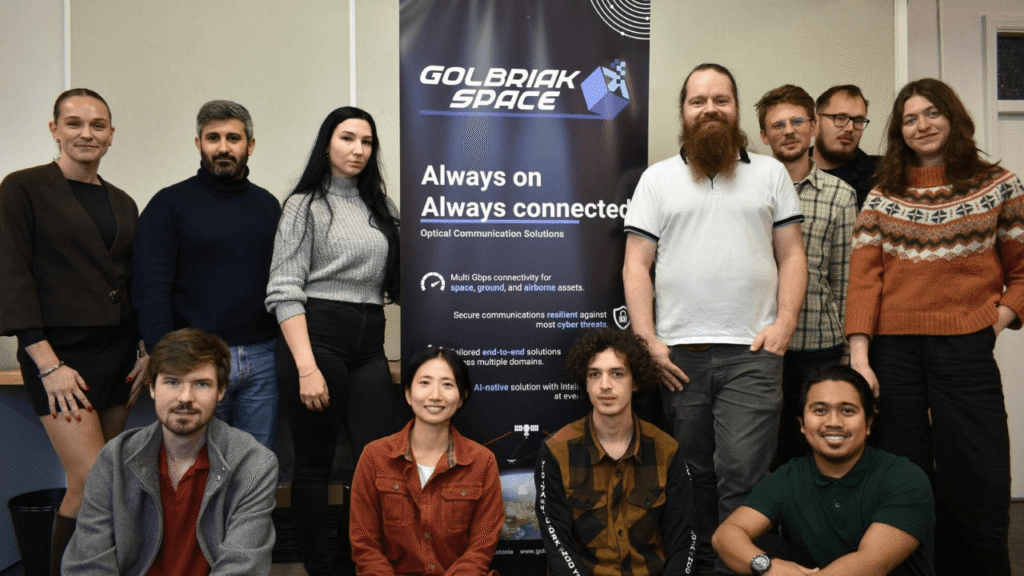
As satellite networks expand and demand for faster data transmission grows, the technology connecting spacecraft is becoming just as important as the satellites themselves. Estonian company Golbriak Space is working to make laser based communications practical for large scale deployment, developing optical terminals designed to move data between space and airborne platforms with greater capacity and easier integration. The company has secured €4 million in seed funding to industrialise its technology and prepare for customer programmes involving thousands of terminals.
The funding round was co led by Join Capital and PhotonVentures, with participation from Takeoff, an aerospace and advanced hardware startup acceleration programme within Italy’s CDP Venture Capital National Accelerator Network, managed by Plug and Play.
The investment was made through Golbriak Space’s Italian holding company, Iribits S.r.l., to support the development and industrialisation of its Estonian operating subsidiary, Golbriak Space OÜ.
Making Laser Communications Scalable
Laser communications use highly focused beams of light to transmit information between devices. Unlike conventional radio frequency communications, optical links can support high data throughput without competing for increasingly congested radio spectrum.
Their narrow beams can also make interception more difficult because an unintended receiver must gain access to the beam path and establish suitable alignment. However, turning these technical advantages into commercially viable products requires terminals that are reliable, affordable to manufacture and straightforward to integrate into different platforms.
Golbriak is targeting this challenge by developing optical communication systems designed for repeatable manufacturing and deployment. As satellite constellations become larger and more interconnected, operators increasingly need communications hardware that can be produced in hundreds or thousands of units rather than built individually for each mission.
One Platform for Space and Airborne Systems
Golbriak is scaling two principal product families, ERMESAI+ for space applications and ARES for airborne platforms.
Both systems use a common, software defined architecture intended to simplify integration and operation across different spacecraft, aircraft, networks and missions.
A key feature of the company’s approach is reducing dependence on the pointing capabilities of the host platform. This can make integration easier for satellite and airborne manufacturers and potentially allow multiple optical terminals to operate on the same vehicle.
Golbriak designs its optical, electronic, mechanical and software components in house. By controlling the complete communications system, the company aims to optimise performance, manufacturing processes and quality as production volumes increase.
Demand Moves Towards Thousands of Terminals
The new funding comes as Golbriak advances commercial negotiations for programmes that could collectively involve several thousand systems.
According to founder and chief executive Nicola Garzaniti, the company has moved beyond research and development, with functioning products, paying customers and demand expanding towards large scale deployments.
Customer funded deployments across multiple commercial space programmes are expected to expand its operational footprint from 2027. Additional ARES systems are also being prepared for airborne applications.
This potential demand is significant because satellite constellation operators require consistent hardware that can be integrated across large fleets. Suppliers able to manufacture optical terminals at scale could play an important role in enabling high capacity communications between spacecraft and other platforms.
Investors Back Industrial Expansion
Join Capital and PhotonVentures see Golbriak’s combination of photonics engineering and scalable product architecture as an opportunity to supply the expanding global space communications market.
The €4 million round will help the company move from existing product validation towards greater manufacturing capacity. It will also support the engineering and operational work required to meet customer requirements as commercial programmes progress.
For Golbriak, the immediate priority is turning its technology into a dependable industrial product that customers can deploy repeatedly across different missions.
Building the Infrastructure for Connected Space
The growth of satellite constellations is increasing the need for communications systems that can handle larger volumes of data without relying exclusively on radio links. Laser communications offer one potential solution, but widespread adoption depends on cost, reliability and ease of integration.
Golbriak Space is positioning its terminals to address these practical challenges. With fresh capital, established products and prospective large scale orders, the company is moving towards industrial production.
Its next stage will depend on converting advanced negotiations into commercial deployments and demonstrating that optical communication terminals can be manufactured and operated reliably at constellation scale.