
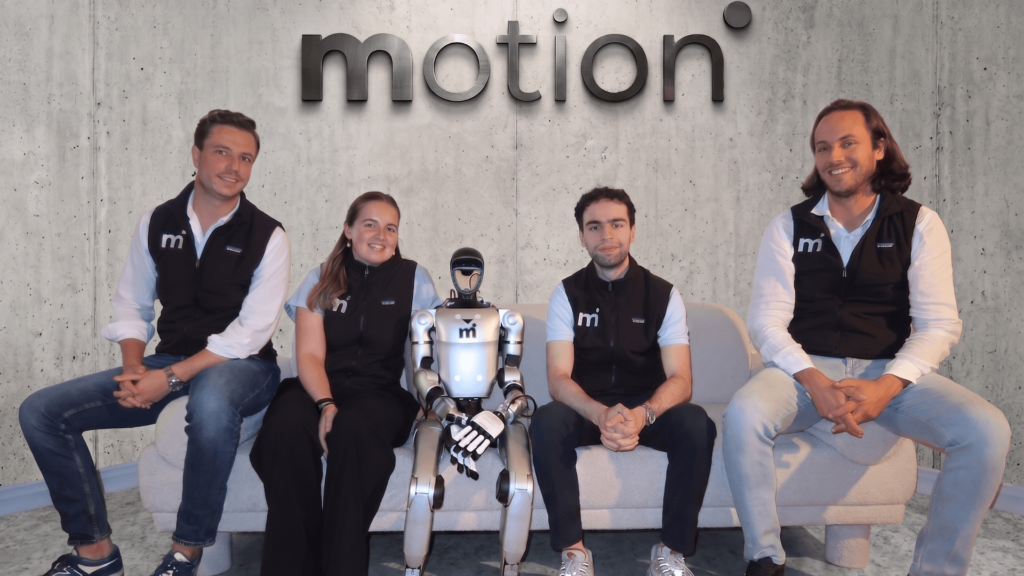
Humanoid robots are moving from futuristic demonstrations into factories and warehouses, but for many European businesses, the biggest obstacle is not the robot itself. Financing, integration, maintenance and compliance can make deployment difficult. Brussels based robotics startup Motion is taking a different approach, offering humanoid machines through a subscription model that aims to make adopting robotic workers as straightforward as hiring human staff.
The company has raised $2 million in pre seed funding to expand its Humanoids as a Service platform and move existing industrial pilots toward commercial deployment.
Robots Without the Upfront Cost
Founded in 2026, Motion provides humanoid robots to industrial, warehouse and logistics companies through a monthly subscription.
Instead of requiring customers to purchase expensive machines and build the infrastructure needed to operate them, Motion packages deployment and ongoing support into one service.
The offering covers robot selection, data collection, task training, IT integration, fleet management, financing, insurance, compliance and maintenance.
The model is designed to reduce both the financial commitment and operational complexity associated with introducing humanoid robots into existing workplaces.
Five Industrial Pilots Underway
Motion is currently running five pilots with industrial, warehouse and logistics companies in Belgium.
During these deployments, humanoid robots are being trained to perform practical tasks alongside existing employees. These include loading goods into crates, packing containers into boxes and placing components onto conveyor belts.
The pilots are intended to demonstrate how humanoid robots can operate within real industrial environments rather than controlled laboratory conditions.
Motion believes this approach could help European manufacturers address persistent labour shortages, particularly in operational roles that can be difficult to fill.
Tackling More Than the Robot
According to Motion, companies interested in humanoid robotics face a range of challenges that extend beyond hardware.
Businesses need to determine how robots will be financed, integrated with existing systems and managed within their operations. They must also consider insurance, regulatory requirements, worker safety and long term maintenance.
Motion is attempting to take responsibility for these issues itself and provide customers with a predictable monthly cost.
Founder and CEO Alexander Stevens said the company wants to make hiring a robot as easy as hiring a person by removing the financial, operational and compliance barriers between factories and their first humanoid machine.
Hardware Agnostic Approach
Motion is not tied to a single humanoid robot manufacturer.
Its hardware agnostic model allows customers to use robots that are best suited to particular tasks without requiring them to commit to one manufacturer.
The company is also developing a European software layer that allows experience gained during deployments to be applied across its network. At the same time, individual customers retain control over their data.
This architecture is intended to give businesses greater flexibility as humanoid robotics technology develops and new robot manufacturers enter the market.
Opening the Platform to Partners
Motion is also expanding beyond direct deployments through a new partner programme.
The initiative is aimed at system integrators and automation specialists that want to deploy humanoid robots for their own customers. Partners will be able to use Motion’s platform to support robotic deployments without having to build the entire operational infrastructure themselves.
This could allow Motion to expand its reach while leveraging companies that already have relationships with industrial customers.
From Pilots to Commercial Robots
The $2 million round was led by Extantia Capital, with participation from Norrsken Evolve.
Motion plans to use the funding to transition its five existing pilots into full production, increase the size of its robot fleet and expand its team.
The company’s immediate geographic focus is the Benelux region, where it aims to build a stronger presence before expanding further.
With its subscription model, Motion is betting that the future of industrial humanoid robotics will depend not only on building capable machines, but also on making them simple and financially practical for businesses to deploy.