
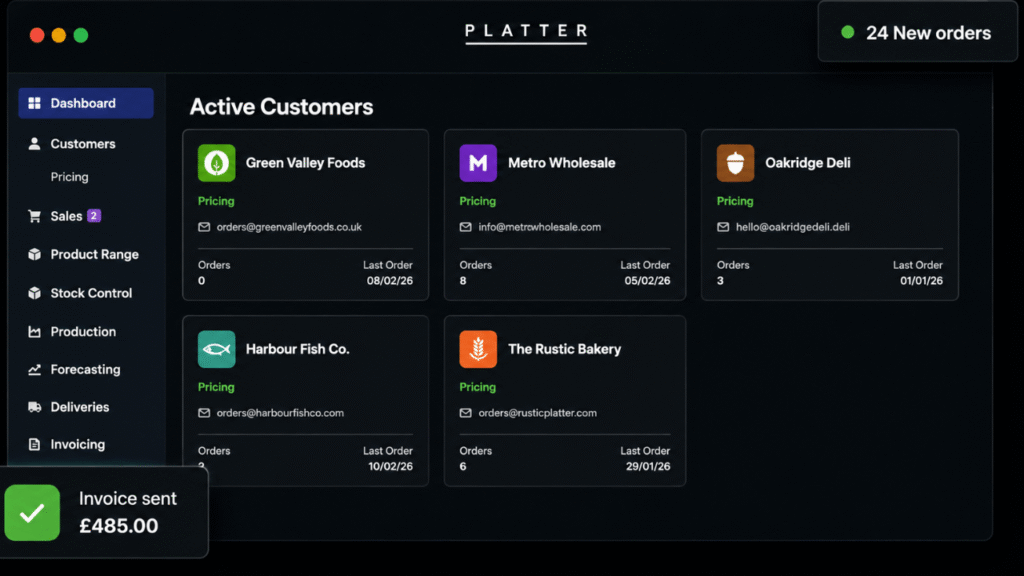
For thousands of food businesses across the UK, the most important technology may still be the spreadsheet sitting at the centre of daily operations. Orders, customer specific pricing, stock, production, deliveries and invoices often move between spreadsheets, emails and disconnected software, creating administrative work and leaving teams without a single view of the business. UK startup Platter is aiming to change that by building a food specific operating system that connects the commercial, operational and financial sides of the supply chain in one platform.
The company has raised an extension to its latest venture funding round, with Verb Ventures joining the investor group as Platter continues to expand its technology for food suppliers, wholesalers and manufacturers.
Platter’s platform is designed specifically around the workflows of food businesses rather than adapting generic business software to the sector. Its goal is to bring ordering, sales, operations, finance and payments together while connecting with the systems companies already use.
Bringing Food Operations Into One System
Platter’s platform is organised around three connected areas.
The first covers orders and sales, including digital ordering, online storefronts, sales management and customer specific pricing. The second focuses on operations, with tools for delivery planning, stock management and production visibility. The third connects finance and accounting, allowing invoices to be automated and synchronised with accounting platforms such as Sage, Xero and QuickBooks.
Rather than forcing food companies to abandon their existing software, Platter is designed to sit between their different systems and connect them. Its integrations can bring together ERP, CRM, accounting, EDI, warehouse and logistics information, creating a central source of real time operational data.
Replacing Spreadsheet Driven Workflows
Food manufacturers and wholesalers often handle highly specific commercial information, including buyer dependent pricing, changing stock levels, delivery requirements, production schedules and product specifications.
When those processes are managed separately, employees can spend significant amounts of time re entering information, checking records and reconciling different versions of the same data.
Platter aims to automate these processes. Orders can flow into stock information, delivery documents can be generated and invoices can be created automatically, reducing manual administration and potential errors. The company says its customers typically recover between 20% and 25% of their time previously spent on manual administrative work.
Turning Transactions Into Financial Infrastructure
Platter is also moving beyond operational software by connecting food suppliers with financial services.
Its platform can automatically generate invoices from orders and connect them with accounting systems. Through its financing partner, suppliers can also access invoice factoring, allowing them to receive payment sooner rather than waiting for standard buyer payment terms. Platter says customers can potentially receive funds 30, 45 or 60 days earlier, providing an additional source of working capital. (Platter)
This creates a potential path for Platter to expand from software into broader embedded financial services as more transaction data flows through the platform.
Building a Food Specific Data Layer
The company’s longer term ambition extends beyond digitising existing processes. Once orders, inventory, pricing, production and financial information are connected, businesses can use that data for more advanced decision making.
Platter says its platform provides the foundation for AI powered tools such as pricing analysis, buyer insights, demand forecasting and real time alerts. The company believes centralising operational data can help food businesses identify risks earlier, understand margins more precisely and respond faster to changing demand.
Scaling a Growing Customer Base
Platter has been commercially live since 2025 and is targeting food businesses that need an integrated system without replacing their entire existing technology stack.
The company was founded by a team with deep experience in the food industry and technology. CEO and founder Jack Clegg has more than two decades of wholesale food experience, while CTO and co founder Andrew Johnson brings more than 25 years of technology leadership.
With its latest funding extension and growing investor support, Platter is positioning itself as more than another ordering or accounting tool. Its ambition is to become the operational infrastructure connecting how food businesses sell, produce, deliver, invoice and ultimately get paid.