
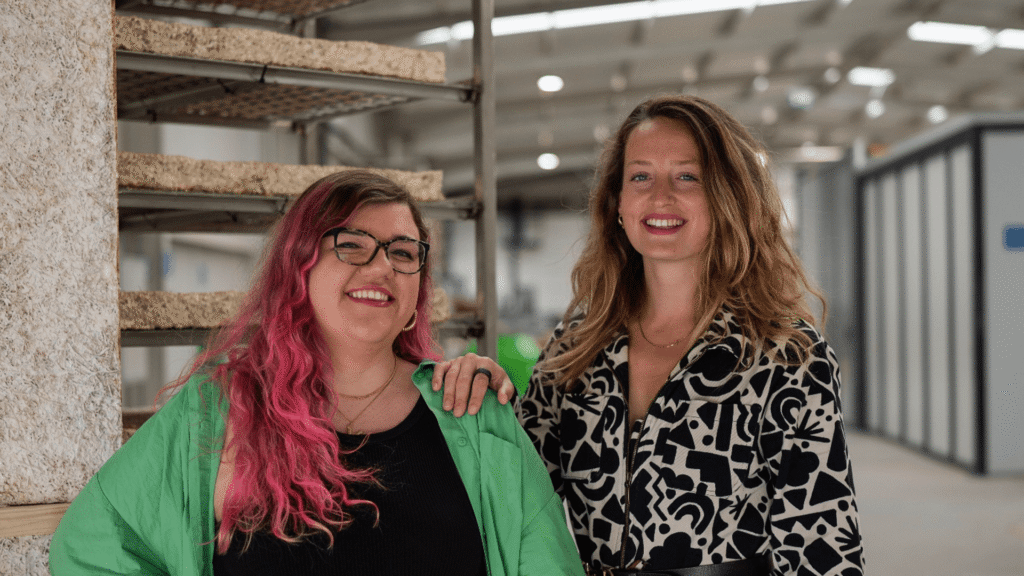
The construction industry is facing mounting pressure to reduce its environmental impact as governments, developers, and investors increasingly focus on lowering carbon emissions across the built environment. Traditional building materials such as concrete, insulation foams, and synthetic construction products continue to contribute significantly to global emissions while also generating large amounts of waste and resource consumption. As sustainability regulations tighten across Europe and demand grows for greener infrastructure, biotechnology company Mykor is developing an alternative approach that transforms industrial and agricultural waste into scalable low carbon construction systems.
UK based Mykor has secured £4 million in funding to accelerate the scale up of its industrial biofabrication technologies.
The funding round was led by Clean Growth Fund, with participation from the British Business Bank’s South West Investment Fund through The FSE Group, alongside Green Angel Ventures and support from Innovate UK through its investor partnership programme.
The company plans to use the new funding to scale production capabilities and expand into additional markets across the UK and Europe.
Turning Waste Into Construction Materials
Founded in 2021, Mykor develops construction systems using engineered mycelium, green chemistry, and industrial manufacturing processes.
The company focuses on converting agricultural and industrial waste streams into low carbon building products designed to meet commercial construction standards.
Rather than positioning itself solely as a materials producer, Mykor describes its business as a technology and process platform intended to integrate biomaterials into existing manufacturing lines and construction supply chains.
Its approach is designed to help contractors and manufacturers adopt lower carbon materials without requiring major changes to industrial production infrastructure.
Building Materials Designed for Mainstream Adoption
One of the biggest challenges facing sustainable construction materials has been balancing environmental performance with cost, durability, and scalability.
According to Olivia Page, Mykor was built around the idea that decarbonising construction cannot come at the expense of practicality or commercial viability.
The company argues that the challenge is not simply inventing biomaterials but manufacturing them efficiently at industrial scale while ensuring they can integrate into existing construction workflows.
Mykor’s first commercial product, MykoSIP, is a prefabricated partition wall system designed to reduce embodied carbon while maintaining thermal and acoustic performance comparable to conventional construction materials.
The company says the production process also consumes significantly less water and electricity than traditional polystyrene based systems.
Responding to Regulatory Pressure
The funding comes at a time when construction companies across the European Union and the United Kingdom are facing growing regulatory pressure to reduce both operational and embodied carbon emissions in buildings.
Embodied carbon, which refers to emissions generated through material production and construction processes, is becoming an increasingly important focus area within the property and infrastructure industries.
At the same time, demand is growing for construction systems that can meet stricter fire safety, energy efficiency, and sustainability requirements without significantly increasing project costs.
Mykor believes biomaterials and industrial biofabrication technologies will become an increasingly important part of future low carbon construction supply chains.
Scaling Commercial Deployment
The company says it is already involved in active construction projects and has secured large offtake agreements with contractors across the UK and Europe.
With the new funding secured, Mykor plans to continue scaling production while expanding commercial partnerships and market reach.
As governments and industries push toward net zero targets, companies capable of combining biotechnology, waste recycling, and scalable industrial manufacturing are becoming increasingly important players in the future construction ecosystem.
Mykor is positioning itself at the intersection of those trends by developing bio based construction systems designed not only to lower emissions, but also to integrate seamlessly into mainstream building supply chains at industrial scale.