
As demand for robotics, satellites, AI hardware, and advanced electronics accelerates globally, the process of manufacturing circuit boards and hardware systems remains surprisingly outdated. Many hardware companies still rely on fragmented supply chains, manual production processes, and overseas manufacturing networks built decades ago for large scale mass production rather than rapid innovation. US based electronics manufacturing company CircuitHub is aiming to modernise that system through automation, robotics, and AI driven manufacturing infrastructure, and investors are backing the company with fresh funding.
CircuitHub has raised $28 million in funding led by Plural. The company says the investment will support the expansion of its automated manufacturing facilities across the United States and Europe, grow its engineering team, and extend its platform into full service electronics manufacturing.
Rethinking Electronics Manufacturing
Founded by Andrew Seddon, CircuitHub has developed what it describes as the first automated electronics manufacturing system capable of transforming digital design files into production ready printed circuit boards within days.
The company’s research and development roots are based in Cambridge, while its growing London team forms the foundation for a broader European manufacturing footprint. CircuitHub launched its first production facility in Massachusetts to remain close to early customers and rapidly evolving hardware startups.
The startup argues that modern electronics manufacturing remains heavily optimised for large scale mass production even though most hardware projects today involve production volumes below 10,000 units.
As a result, companies building emerging technologies often face long development cycles, expensive supply chain management, and slow iteration processes that can delay innovation significantly.
Bringing Semiconductor Style Automation to Hardware
CircuitHub’s model draws inspiration from semiconductor fabrication plants, which are among the world’s most automated manufacturing systems.
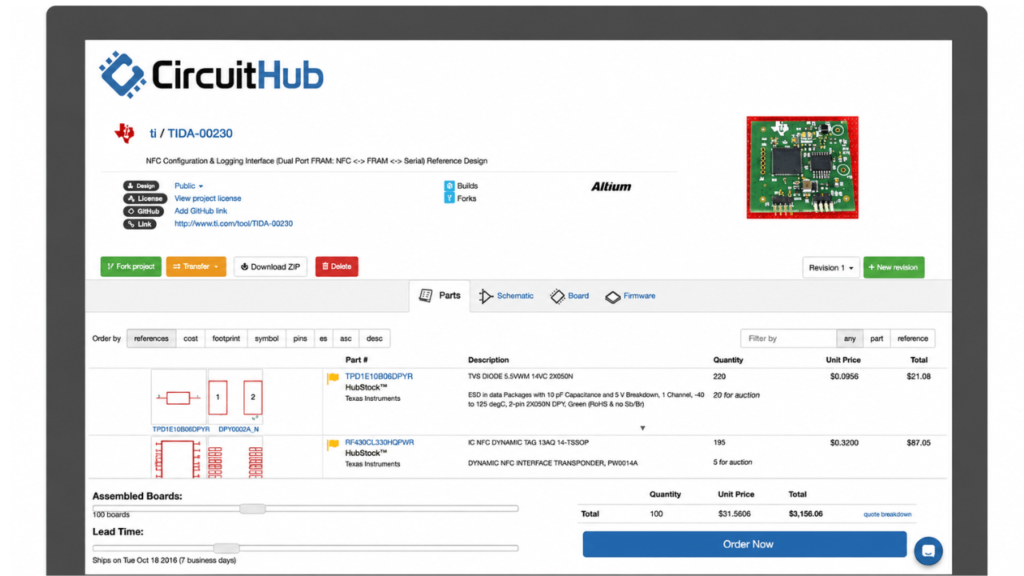
Through the company’s online platform, engineers developing products such as autonomous vehicles, satellites, robotics systems, and AI hardware can upload digital designs and order circuit boards almost instantly.
Once uploaded, CircuitHub uses robotics, computer vision systems, automation software, and AI driven production management inside its first 5,000 square foot manufacturing facility known as “the Grid.” The factory is designed to handle both single prototypes and batches of up to 10,000 units across multiple product designs simultaneously.
By automating much of the production process while maintaining quality oversight through a small onsite team, CircuitHub says it can reduce manufacturing timelines from months to days.
Making High Mix Manufacturing Economically Viable
Traditional electronics manufacturing is generally optimised for producing very large volumes of identical products. CircuitHub instead focuses on “high mix” manufacturing, where many different hardware designs are produced in smaller quantities.
The company believes this model is increasingly important as industries such as robotics, space technology, energy systems, defence, and AI hardware demand faster experimentation and more specialised product development.
According to Andrew Seddon, hardware companies have historically faced a difficult choice between building expensive in house manufacturing infrastructure or depending on ageing Western supply chains and overseas production networks.
He described CircuitHub as a shared manufacturing platform where hardware companies can access advanced factory infrastructure remotely through a browser or even AI driven workflows, similar to how software companies access shared cloud computing infrastructure today.
Expanding Domestic Manufacturing Capacity
Since launching its Massachusetts facility, CircuitHub says it has delivered more than two million circuit boards and placed over 133 million electronic parts while serving more than 20,000 engineers globally.
The company says it has become the fastest growing electronics manufacturer in the United States and now plans to expand its Grid manufacturing model across both the US and Europe.
Investors believe the company’s approach could play a broader strategic role in strengthening domestic manufacturing resilience and reducing dependence on overseas electronics supply chains increasingly exposed to geopolitical risks.
Sten Tamkivi said CircuitHub is fundamentally changing the economics of electronics manufacturing by combining robotics, software, AI, and automation into a more scalable and accessible infrastructure model.
As industries increasingly depend on advanced hardware systems, companies capable of accelerating local manufacturing capacity while shortening product development cycles are attracting growing attention from both investors and governments focused on technological sovereignty and industrial resilience.