
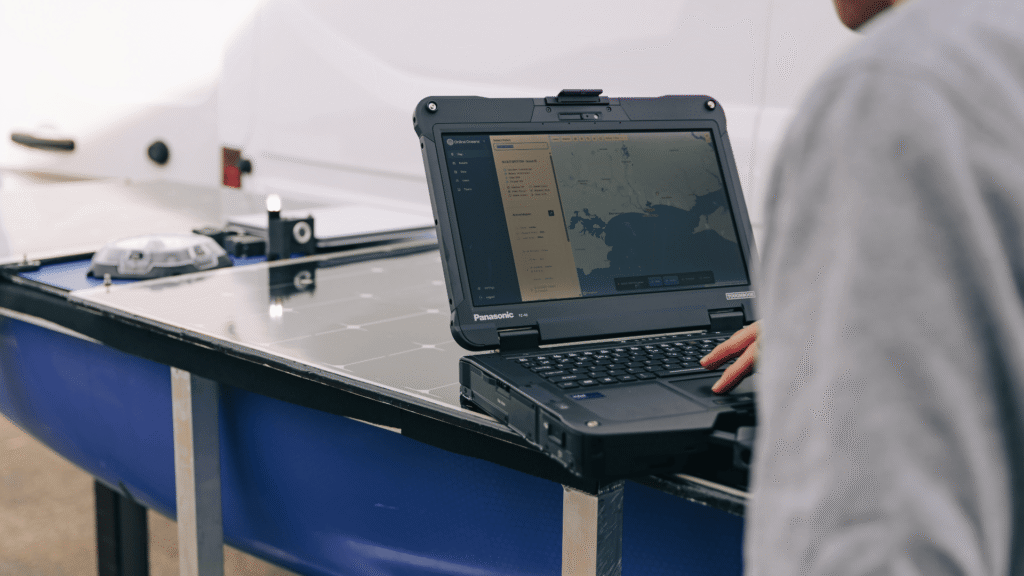
UK based maritime defence startup Online Oceans has secured £4 million in funding as it works to transform how oceans are monitored and protected. By combining autonomous vessels with cloud based control systems, the company aims to deliver persistent and scalable maritime coverage for both defence and commercial applications.
Investor Backing and Strategic Support
The funding round was led by Seraphim Space, with participation from investors including Peter Rive, Frank Thieser, Florian Seibel, and Koro Capital. The investment reflects growing interest in technologies that enhance maritime security and operational efficiency.
The newly raised capital will be used to scale manufacturing capabilities, support deployments, and expand the company’s operations to meet increasing global demand.
A New Approach to Ocean Monitoring
Founded in 2025 by George Morton and Alistair Douglas, Online Oceans is focused on enabling continuous maritime awareness. Traditional monitoring methods often rely on crewed vessels, which are expensive to operate and limited in duration.
Autonomous systems offer an alternative, but many existing solutions lack the scalability required for large scale deployments. Online Oceans is addressing this gap by developing an integrated platform that supports dense, continuously connected fleets.
Autonomous Vessels and Cloud Control
At the core of the company’s offering is Scout, a compact autonomous surface vessel powered by solar energy. Designed for long duration missions, Scout can operate independently for extended periods, reducing the need for human intervention.
Complementing this hardware is Tether, a cloud based command and control platform that enables operators to manage fleets in real time. Through Tether, users can monitor vessel activity, coordinate missions, and access data from multiple assets simultaneously.
This combination of autonomous hardware and software creates a unified system that enhances visibility and control across maritime environments.
Applications Across Defence and Security
Online Oceans is targeting a range of critical use cases, particularly within defence and security. These include anti submarine warfare, protection of subsea infrastructure, border surveillance, and efforts to combat illegal activities such as drug smuggling.
By enabling continuous monitoring, the platform provides a more comprehensive understanding of maritime environments, helping organisations respond more effectively to emerging threats.
The ability to deploy multiple vessels as part of a connected fleet also increases coverage while maintaining cost efficiency.
Addressing Cost and Scalability Challenges
One of the key advantages of Online Oceans’ approach is its focus on reducing operational costs. Crewed vessels require significant resources, including personnel, fuel, and maintenance, making large scale monitoring difficult.
Autonomous fleets powered by renewable energy offer a more sustainable and scalable solution. By lowering costs and increasing coverage, the company aims to make persistent maritime surveillance more accessible to a wider range of organisations.
Expanding for Global Demand
With fresh funding, Online Oceans is preparing to scale its manufacturing processes and deploy its technology in real world environments. While the company is building its operations in Europe, its solutions are designed to address global needs.
The increasing importance of maritime security, combined with growing concerns around infrastructure protection and environmental monitoring, is driving demand for advanced surveillance technologies.
Shaping the Future of Maritime Operations
CEO George Morton has emphasised that the company’s mission is to provide a practical and scalable way to monitor critical waters over extended periods. By combining autonomy, connectivity, and data driven insights, Online Oceans is positioning itself as a key player in the evolution of maritime operations.
As the need for persistent and cost effective monitoring continues to grow, the company’s integrated approach offers a glimpse into the future of how oceans will be managed and protected.