
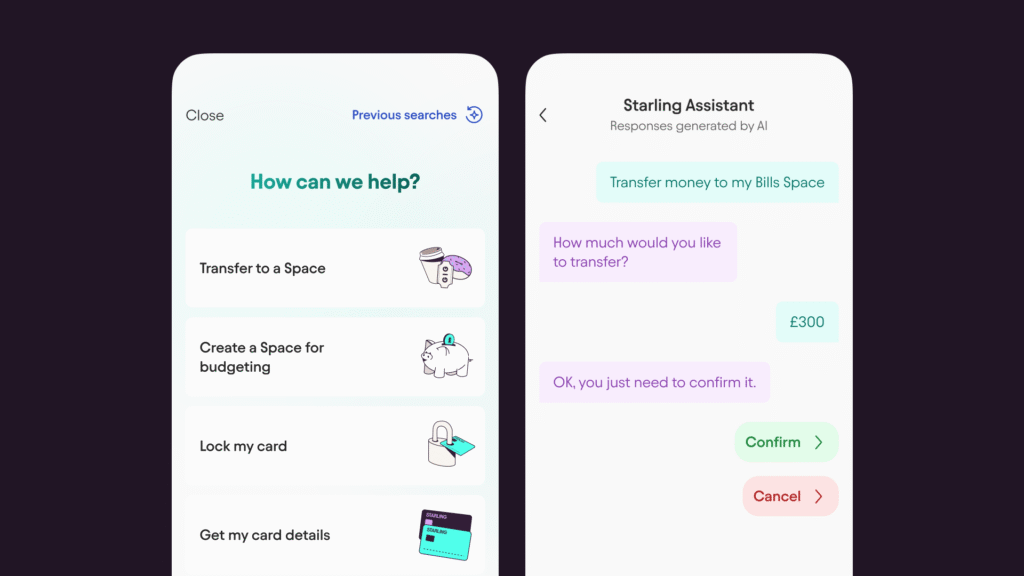
As artificial intelligence begins to move from passive tools to systems that can take action on behalf of users, banking is entering a new phase of automation. Starling Bank has introduced what it describes as the UK’s first agentic AI financial assistant, designed to actively help customers manage their finances through natural language and voice interactions.
The new feature, called Starling Assistant, marks a shift from traditional digital banking interfaces toward more interactive and personalised financial support. With nearly five million customers, the bank is positioning the tool as a way to simplify everyday money management while introducing a new layer of automation into routine financial tasks.
Moving beyond traditional banking apps
Digital banking has largely focused on providing users with visibility into their finances and tools to perform specific actions. However, many tasks still require manual input, navigation through menus, and repeated setup processes.
Starling Assistant aims to streamline these interactions by allowing customers to communicate with their bank in natural language. Instead of navigating through multiple screens, users can simply describe what they want to achieve, and the assistant will interpret the request and carry out the necessary actions.
This approach reflects a broader trend in technology, where interfaces are becoming more conversational and intuitive, reducing the complexity of interacting with digital systems.
Automating everyday financial tasks
The assistant is designed to handle a range of day to day banking activities. Customers can use it to set up savings goals, organise their finances into different categories, and manage recurring payments.
For example, a user planning a future expense can ask the assistant to calculate how much needs to be saved each month and automatically set up transfers into a dedicated account. Similarly, customers can organise their income into separate spending categories, such as bills, groceries, and leisure, with the assistant managing the distribution of funds.
By automating these processes, the system helps users maintain financial discipline without requiring constant manual effort.
Personalised insights and guidance
In addition to executing tasks, Starling Assistant provides personalised insights based on a customer’s financial behaviour. This includes helping users understand their spending patterns and offering guidance on how to manage their money more effectively.
The assistant builds on earlier AI driven features introduced by the bank, such as tools that allow customers to query their spending in natural language and systems designed to identify potential scams.
By combining these capabilities, Starling is creating a more comprehensive financial assistant that not only informs users but also acts on their behalf.
Powered by advanced AI infrastructure
The assistant is built on Starling’s proprietary technology platform and incorporates advanced AI models through Google Gemini and Google Cloud technologies. This combination enables the system to process natural language, understand context, and execute tasks within the banking environment.
The use of agentic AI represents a step forward from earlier generative AI tools, as it allows the system to take action rather than simply generate responses. This shift is central to the concept of an assistant that can actively manage aspects of a user’s financial life.
Growing competition in AI driven banking
Starling’s move comes as financial institutions across Europe explore the potential of AI in banking. Several fintech companies are already experimenting with similar technologies, using AI for customer support, financial insights, and automation.
The introduction of agentic systems marks the next stage in this evolution, where AI is not only used to answer questions but also to perform tasks and manage workflows. As competition intensifies, banks are increasingly looking to differentiate themselves through more advanced and user friendly digital experiences.
A step toward autonomous finance
With the launch of Starling Assistant, the bank is signalling its intention to lead in the adoption of AI driven financial tools. The goal is to create a banking experience where routine tasks are handled automatically, allowing customers to focus on broader financial goals.
As AI technology continues to develop, the role of digital assistants in banking is likely to expand further. Systems that can understand user intent, adapt to individual needs, and take action autonomously could redefine how people interact with their finances.
By introducing an assistant that combines conversational interfaces with actionable capabilities, Starling is taking an early step toward this future, where managing money becomes more intuitive, automated, and personalised.