
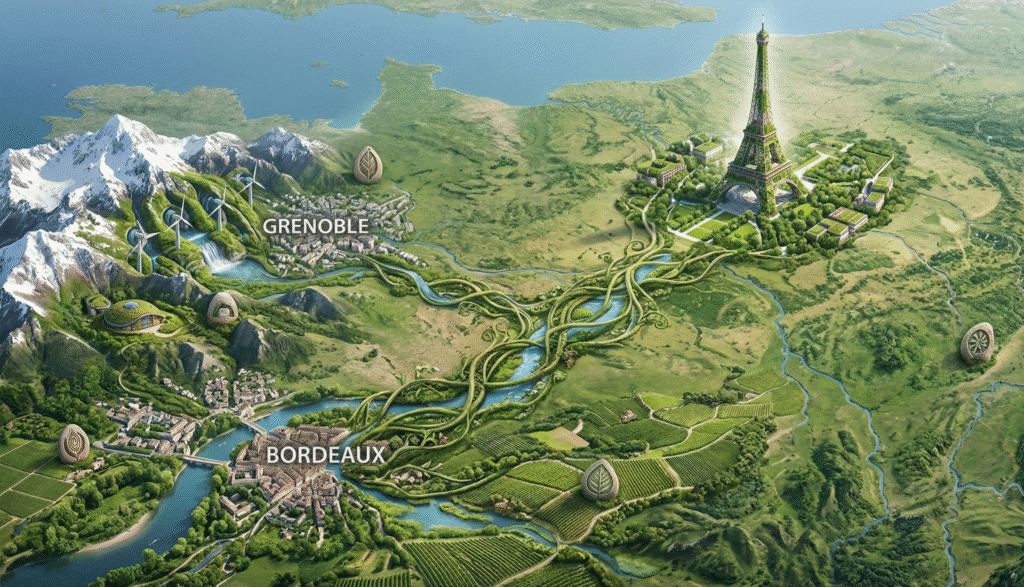
While Paris officially dominates the European artificial intelligence landscape with 14-figure software valuations, a fundamentally different technological revolution is happening 500 kilometres outside the capital. Climate technology, particularly heavy industrial hardware, cannot be built in a cramped 50-square-meter Parisian coworking space. It requires massive physical footprints, deep integration with regional academic research centres, and a highly specialised manufacturing workforce.
For institutional investors mapping the European tech funding landscape, the 2026 data heavily pivots toward the provinces. A new decentralised ClimateTech corridor is rapidly maturing, anchored by the deep tech fortress of Grenoble in the east and the renewable energy hub of Bordeaux in the west. These 2 cities successfully leverage the €54B France 2030 sovereign investment plan to build the actual physical infrastructure required to decarbonise the European continent.
Grenoble: The Deep Tech and Battery Fortress
Grenoble has historically been the undisputed capital of the French Alps, but it now serves as the engine room of European industrial sovereignty. The European Commission officially recognised this momentum in late 2025 by awarding Grenoble the 2026 European Capital of Innovation Award, accompanied by a €1M prize. The ecosystem is inextricably linked to the French Alternative Energies and Atomic Energy Commission (CEA), which acts as a highly aggressive incubator for hardware spinouts.
The scale of the capital flowing into the Grenoble ecosystem is unprecedented. The flagship example is Verkor, a battery manufacturer actively building gigafactories to supply the European electric vehicle market. Verkor recently secured €1.3B in debt financing, driving its valuation to over €3.5B. They provide the exact sovereign manufacturing capabilities that the European Union desperately needs to counter Asian battery dominance.
This heavy industrial focus extends beyond traditional batteries. Inocel, a direct CEA spinout born in Grenoble, recently raised a €32M equity round stacked on top of €32M in debt and state subsidies to manufacture high-power hydrogen fuel cells for heavy-duty maritime transport. Simultaneously, Renaissance Fusion closed a €31M round to accelerate commercial high-temperature superconductors. When venture capitalists deploy capital in Grenoble, they do not fund software iterations; they fund deep physics that can redefine global energy grids.
Bordeaux: The Agritech and Blue Economy Hub
If Grenoble dominates thermodynamics, Bordeaux completely rewrites the biological and renewable energy playbooks. By utilising its historical agricultural legacy and direct proximity to the Atlantic coastline, the Nouvelle-Aquitaine region cultivates a highly lucrative Cleantech ecosystem.
Bordeaux startups are proving that circular economy models can generate massive enterprise valuations. TOOPI Organics secured €23M to industrialise a proprietary technology that converts human urine into an incredibly efficient alternative to chemical fertilisers. This directly addresses massive supply chain vulnerabilities within global agriculture.
The region also aggressively taps into the blue economy and renewable thermal sectors. Seaturns recently secured €2.45M to commercialise its wave energy converters, aiming to deploy resilient clean electricity directly from ocean swells. Meanwhile, Newheat raised an impressive €42.9M to scale its renewable thermal energy solutions for large industrial sites. Bordeaux founders address the systemic climate challenges facing the European B2B software sector by applying hard engineering solutions in the physical world.
Bridging the €13.5B Series B Gap
Despite the massive seed-stage innovation occurring in these 2 regional hubs, founders still face a brutal macroeconomic reality. The European climate tech sector currently faces a significant structural void. Funding for European climate tech fell 71% in the 1st half of 2025, dropping to €6.2B from the €21.7B high recorded in 2024.
According to 2026 data from the Cleantech Group, Europe faces a €13.5B Series B funding shortfall compared to the United States. Only 14.7% of European climate tech startups that successfully raise a seed round manage to secure a Series B, compared to 24.5% in the US. The core problem is that European institutional investors remain highly risk-averse when it comes to funding the €25M to €100M growth rounds required to build physical manufacturing plants, as late-stage venture capital is pivoting back toward defence tech and AI.
To survive this late-stage capital drought, startups in Grenoble and Bordeaux rely heavily on blended finance models. They aggressively combine private venture capital with massive public grants from Bpifrance and the European Investment Bank (EIB). In 2025 alone, the EIB Group invested €13B in France, with 61% explicitly dedicated to climate action. This state-backed derisking strategy is the only reason these regional hardware startups survive the capital chasm and reach commercial scale.
Sovereignty Requires Land
The French government realises that achieving true net-zero emissions and securing industrial sovereignty cannot be accomplished through software alone. You cannot code a gigafactory, and you cannot build a nuclear fusion reactor in the centre of Paris.
Grenoble and Bordeaux offer the physical land, specialised academic pipelines, and localised political support required to build massive Cleantech infrastructure. For international venture capitalists hunting for the next generation of climate unicorns, the 2026 data is incredibly clear. The most lucrative and defensible hardware investments in Europe currently gestate 500 kilometres outside the Périphérique.