
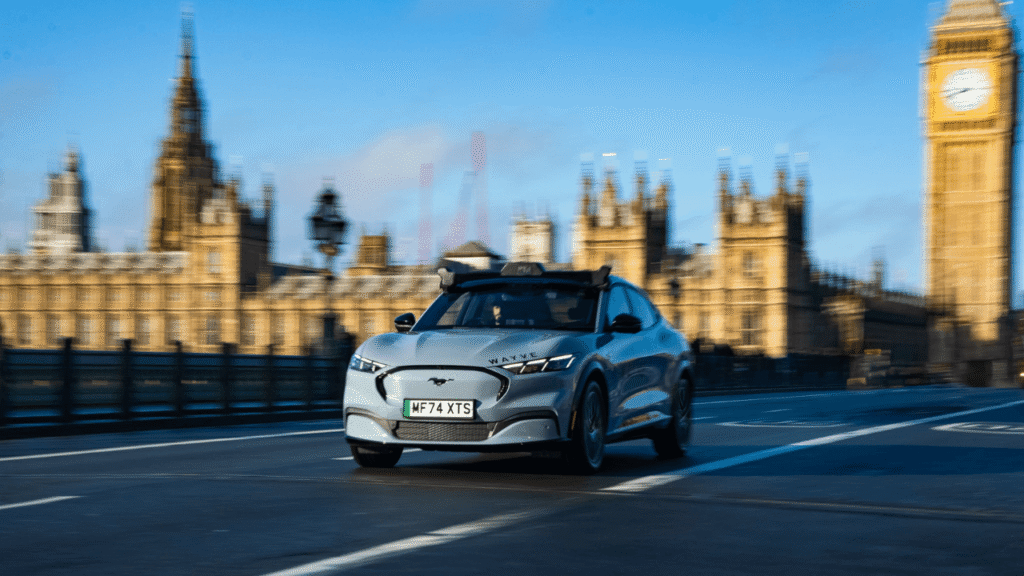
London based autonomous driving company Wayve has raised $1.2 billion in a Series D funding round, pushing its post money valuation to $8.6 billion and marking one of the largest private AI investments in Europe to date. The funding signals a major transition for Wayve, from a company best known for cutting edge research into a business focused on large scale commercial deployment of its end to end autonomous driving platform.
A landmark Series D round
The Series D round was led by Eclipse, Balderton and SoftBank Vision Fund 2, with participation from a broad group of new global institutional investors including Ontario Teachers’ Pension Plan, Baillie Gifford, the British Business Bank, Icehouse Ventures and Schroders Capital. Strategic technology partners Microsoft, NVIDIA and Uber also joined the round, reinforcing Wayve’s position at the intersection of AI, cloud infrastructure and mobility.
Automotive manufacturers Mercedes Benz, Nissan and Stellantis also invested, underlining growing confidence among carmakers in Wayve’s unified AI approach to autonomy across different vehicle classes and markets.
From research to commercial deployment
Founded in 2017, Wayve pioneered the use of end to end AI for autonomous driving, training a single neural network to perceive, predict and drive using onboard sensors alone. Over the past several years, the company has transformed this research into a production ready autonomy platform built around safety by design principles.
Wayve’s technology is designed to support a wide spectrum of autonomy, from L2 plus hands off driver assistance to L3 and L4 eyes off automated driving. From 2026, consumers are expected to encounter Wayve powered robotaxis through commercial trials with Uber. By 2027, passenger vehicles equipped with Wayve’s AI Driver are planned to reach the market, beginning with hands off highway and urban driving under driver supervision.
A licensing first model for autonomy
Rather than building and operating its own vehicle fleets, Wayve licenses its AI Driver directly to automakers. This approach allows manufacturers to customise driving behaviour for specific brands and vehicle platforms while running fully on embedded vehicle compute and sensors. The system does not depend on high definition maps or location specific engineering, which significantly lowers the cost and complexity of global deployment.
By working with automakers and mobility platforms instead of vertically integrating, Wayve aims to scale autonomy across millions of vehicles with far lower capital intensity than traditional robotaxi only strategies.
Proven global generalisation
A key differentiator for Wayve is its ability to generalise across markets. Over the past year, the company became the first autonomous vehicle developer to demonstrate zero shot driving in more than 500 cities across Europe, North America and Japan. This means the system can operate in new cities without prior local fine tuning.
This capability is driven by Wayve’s foundation model, trained on diverse real world driving data from more than 70 countries and across many vehicle types. The result is an autonomy system designed to adapt quickly to new environments, regulations and driving cultures.
Robotaxis with Uber
Uber’s participation in the round is paired with a commitment to support multi year deployments of Wayve powered robotaxis on its platform. The partnership plans to launch its first service in London in 2026, with expansion to more than 10 global markets over time. Under the model, Wayve supplies the AI Driver, participating automakers provide L4 capable vehicles, and Uber owns and operates the fleet.
Building the autonomy layer
According to co founder and CEO Alex Kendall, Wayve’s ambition extends beyond any single vehicle category. The company is positioning itself as the autonomy software layer that can power any vehicle, anywhere, continuously improving through global deployment. With fresh capital and deep industry backing, Wayve is now focused on turning that vision into a scaled commercial reality.