
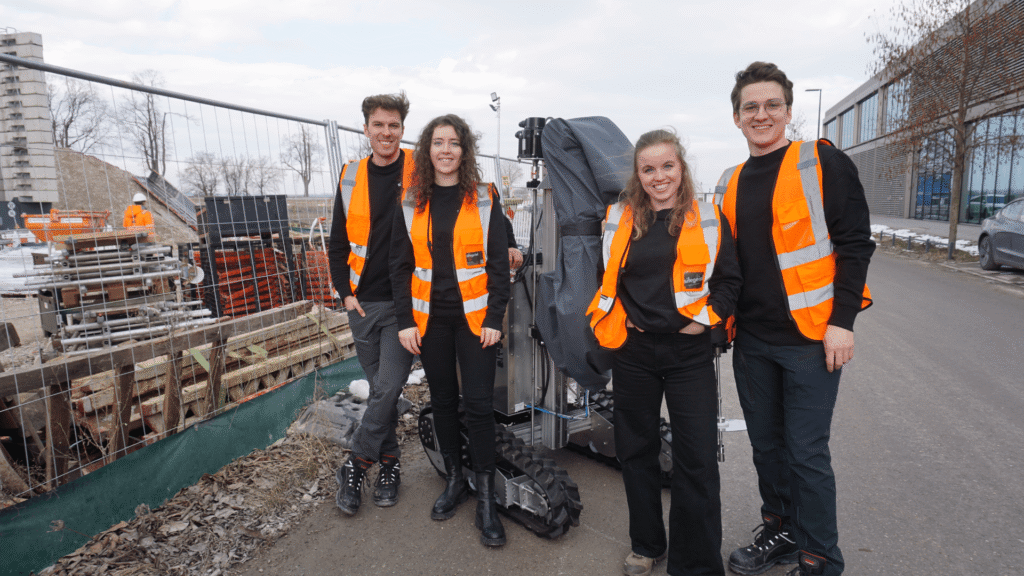
Munich-based construction robotics startup Sitegeist has secured €4 million in pre-seed funding to accelerate the development of automated robots designed for complex concrete renovation projects. The round was co-led by b2venture and OpenOcean, with participation from UnternehmerTUM Funding for Innovators and a group of prominent angel investors, including Verena Pausder, Lea-Sophie Cramer, and Alexander Schwörer, alongside strategic backers from the construction and robotics industries.
A growing infrastructure challenge
Across Europe and North America, critical infrastructure is ageing faster than it can be repaired. Bridges, tunnels, car parks, and public buildings built decades ago are reaching the limits of their original design life. In Germany alone, the backlog for infrastructure repairs runs into the hundreds of billions of euros, placing mounting pressure on public authorities and construction firms alike. Similar conditions are emerging in other industrialised regions, driven by decades of underinvestment, rising safety standards, and increasing usage.
Concrete renovation sits at the centre of this challenge. Repairing reinforced concrete structures is not only labour-intensive but also highly specialised. Removing damaged concrete using techniques such as high-pressure water jets or abrasive blasting requires extreme precision to avoid damaging embedded steel reinforcement. Much of this work is still done manually, often in physically demanding and hazardous conditions, contributing to labour shortages and project delays.
Robotics built for real construction sites
Sitegeist was founded to tackle precisely this bottleneck. Rather than adapting factory-style automation to construction, the company is developing modular robotic systems purpose-built for unstructured renovation environments. Unlike traditional automation solutions that depend on detailed 3D models or standardised site layouts, Sitegeist’s robots are designed to work directly on existing structures, even when conditions vary significantly from one site to another.
The systems combine advanced sensing technologies, AI-based decision support, and adaptive control mechanisms. This allows the robots to understand complex geometries, detect varying material conditions, and adjust their actions in real time, without requiring prior digitisation of the site. As a result, they can be deployed on active renovation projects where conditions change daily and precision is critical.
Addressing a critical bottleneck
According to Dr Lena-Marie Pätzmann, co-founder and CEO of Sitegeist, concrete renovation represents one of the most capacity-constrained areas of the construction industry. Deteriorated concrete is still removed using largely manual methods that are difficult to scale and heavily dependent on skilled labour. By introducing specialised, automated robots that can operate directly on existing structures, Sitegeist aims to improve efficiency, enhance safety, and help contractors complete more projects with limited resources.
The company works closely with concrete renovation firms directly on site, ensuring that its systems are shaped by real-world requirements rather than laboratory assumptions. This close collaboration informs the development of a modular platform that can gradually expand across different stages of the renovation value chain, from surface preparation to more advanced repair tasks.
Backing from construction and tech investors
Investors in the round point to the scale of the infrastructure challenge and the lack of scalable solutions as key drivers behind their support. With labour shortages intensifying and regulatory demands increasing, automation is becoming less of a productivity upgrade and more of a necessity for the construction sector. Sitegeist’s focus on unstructured environments and existing infrastructure sets it apart from many robotics approaches that struggle outside controlled conditions.
Scaling deployment and talent
The new funding will be used to expand Sitegeist’s team, deepen technical development, and accelerate deployments on real construction sites. The company plans to work with additional test sites and co-development partners to further validate its robotic systems under diverse conditions. By doing so, Sitegeist aims to help concrete renovation companies overcome capacity constraints and make large-scale infrastructure renewal more feasible in the years ahead.
As governments and private operators grapple with ageing infrastructure and limited workforces, Sitegeist is positioning itself at the intersection of robotics, AI, and one of construction’s most urgent challenges.