
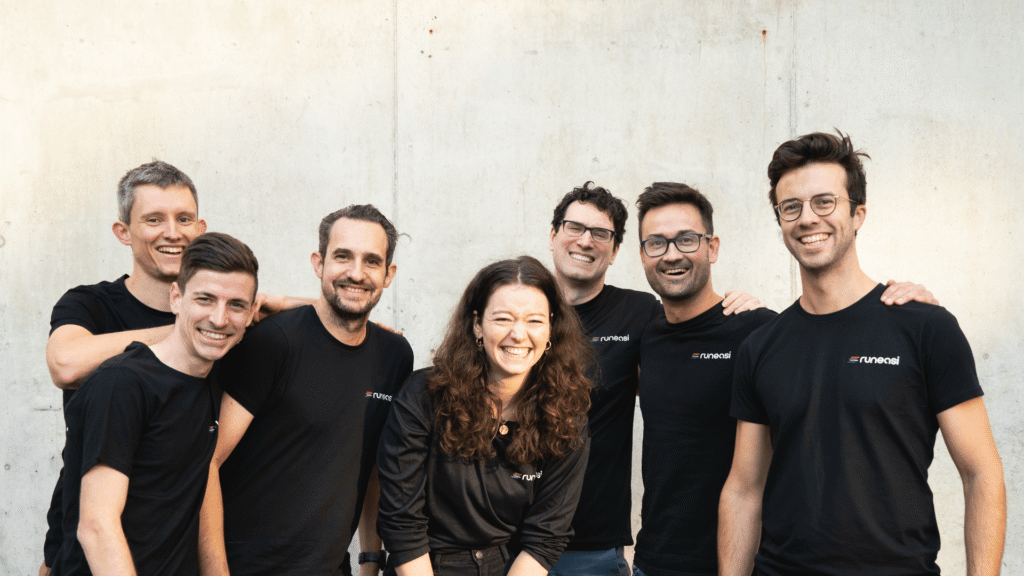
London may dominate the headlines when it comes to sports technology, but a fast-growing Belgian spin-out is quietly reshaping how running performance and injury prevention are analysed worldwide.
Turning biomechanics into everyday practice
Runeasi, a KU Leuven spin-off specialising in running and movement analysis, has raised €1 million in a new investment round to support its next phase of international growth. The round was led by Smarter Ventures, with participation from existing backers Freshmen Fund, Gemma Frisius Fund, the company’s founders, and angel investor Sean Gourley.
Founded on academic research in biomechanics and human movement, Runeasi was built to solve a practical problem faced by physiotherapists, coaches, and running specialists: high-quality movement analysis has traditionally required expensive laboratories, specialist cameras, and time-consuming setups. Runeasi replaces that complexity with a lightweight, AI-powered motion sensor worn in a sports belt, paired with software that translates biomechanical data into clear, actionable insights.
The result is a system that allows practitioners to perform running and jumping analyses in minutes, rather than hours, and without the need for bulky or costly equipment.
From research lab to real-world impact
At the core of Runeasi’s platform is its ability to convert advanced biomechanical measurements into practical recommendations. The sensor captures detailed movement data, which is processed using AI models grounded in scientific research. Practitioners receive personalised reports that support rehabilitation programmes, injury prevention strategies, and performance optimisation plans.
This research-to-practice approach reflects Runeasi’s origins as a university spin-off. Rather than positioning AI as a buzzword, the company focuses on validation, accuracy, and usability. Its tools are designed to fit seamlessly into existing clinical and training workflows, enabling professionals to spend more time with clients and less time interpreting raw data.
Global adoption across sports and healthcare
Runeasi’s platform is now used in more than 40 countries by sports physiotherapy practices, coaches, and speciality running stores. To date, more than 50,000 running analyses have been performed using the system, highlighting strong adoption across both healthcare and performance-focused environments.
The United States has emerged as Runeasi’s largest market, reflecting growing demand for accessible movement analysis tools in sports medicine and fitness. Alongside practitioners, the company also works with sports footwear brands, using its technology to support objective product testing and scientific validation of shoe designs.
By enabling consistent and repeatable analysis, Runeasi helps brands and practitioners alike better understand how runners move, how injuries develop, and how equipment or training changes can improve outcomes.
Funding fuels international expansion
According to CEO Kurt Schütte, the new funding will be used to accelerate Runeasi’s international expansion, with a particular focus on scaling its presence in the United States. At the same time, the company plans to continue serving its Belgian customer base, where it has built strong, long-term relationships since its early days.
The investment will also support continued product development, ensuring that Runeasi’s tools remain aligned with the latest scientific insights while staying easy to use in everyday practice.
Recognition for science-driven AI
At the end of 2025, Runeasi was named among Belgium’s fastest-growing AI scale-ups, a milestone that reflects both its commercial traction and its disciplined approach to technology development.
For Schütte and co-founder and CTO Tim Op De Béeck, the recognition reinforces the company’s philosophy: AI should be a practical tool that delivers measurable value, not a marketing feature. By grounding its platform in validated research and focusing on real-world usability, Runeasi aims to set a standard for how AI can support health, performance, and human movement at scale.
As demand grows for accessible, data-driven insights in sports and healthcare, Runeasi is positioning itself as a bridge between academic biomechanics and everyday practice, helping professionals around the world better understand how people move, train, and recover.