
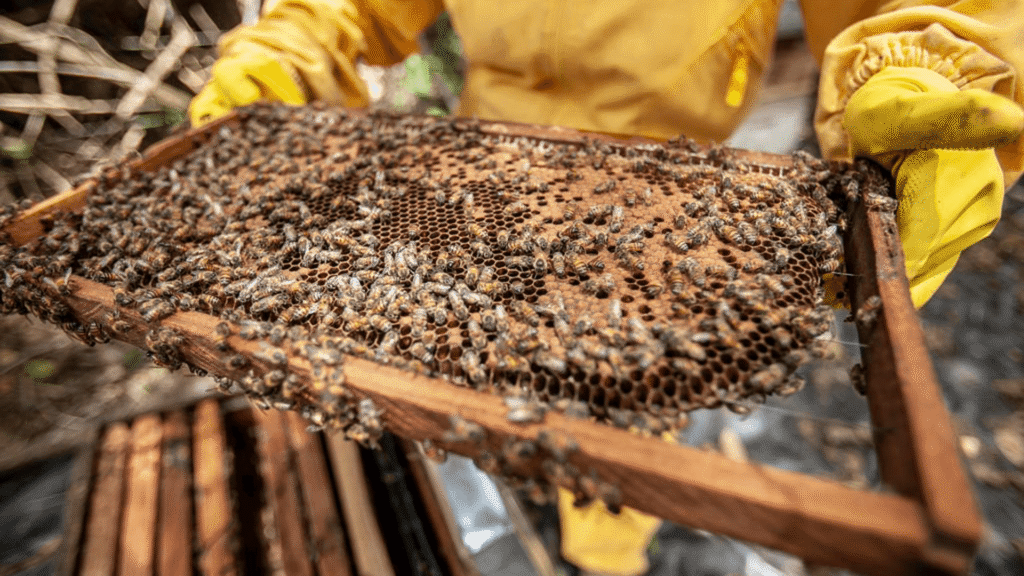
Pollination is one of the most critical yet under-managed inputs in global food production. While a significant share of crops rely on pollinators to deliver yield, quality, and resilience, pollination is still rarely treated as a structured component of agricultural decision making. French agri-tech company UBEES is working to change that narrative and has now raised €8 million in Series A funding to scale its approach globally.
The round was co-led by European funds Starquest and Capagro, with participation from Newtree Impact. The capital will support UBEES in expanding its operations and embedding pollination more deeply into agricultural value chains across multiple continents.
Turning pollination into an operational system
Founded in 2017, UBEES develops pollination programmes that are designed to function as measurable and actionable components of agricultural production. Rather than treating beekeeping as an add-on activity, the company integrates pollination into agronomic planning through structured programmes that combine field expertise, data analysis, and long-term monitoring.
At the centre of its model are connected beehives equipped with sensors and analytical tools. These systems collect data on pollinator activity, hive health, environmental conditions, and surrounding ecosystems. The information is then used to generate recommendations aimed at improving crop productivity, biodiversity, and production stability.
Data-driven insights from the field
The data captured by UBEES goes beyond hive performance. It covers indicators related to crop quality, yield consistency, biodiversity impact, and carbon footprint. This enables clients to better understand the health of their agricultural ecosystems and adapt practices accordingly.
By translating pollination into quantifiable metrics, UBEES allows farmers and brands to assess ecosystem performance alongside traditional agronomic indicators. This approach supports more informed decision making while also helping organisations document environmental and social impact.
Supporting farmers from design to deployment
UBEES positions itself as both a technology provider and an operational partner. The company supports clients throughout the full lifecycle of a pollination programme, from initial design and analysis through to on-the-ground implementation and long-term follow up.
Its teams work directly with farmers, cooperatives, and corporate partners to deploy beehives, interpret data, and adjust agricultural practices over time. This hands-on model is designed to ensure that pollination strategies are adapted to local conditions and remain effective over multiple growing seasons.
Today, UBEES operates in more than fifteen countries across five continents, working with organisations in sectors including agri-food, cosmetics, and energy. Its programmes are applied across a wide range of crops and production systems.
Expanding into key agricultural regions
With the new funding, UBEES plans to accelerate expansion in Latin America and Africa, regions that are critical for pollinator dependent crops such as coffee, cocoa, avocados, and berries. These regions also present significant opportunities to improve farmer incomes and production resilience through better ecosystem management.
At the same time, the company will continue to strengthen its presence in Europe and the United States, where demand for traceable and regenerative agricultural practices is increasing among brands and producers.
Strengthening technology and impact measurement
Part of the investment will be used to further develop UBEES’ connected hive technology, improving sensor capabilities and data quality. The company also plans to enhance its impact measurement frameworks to better capture agronomic, environmental, and economic outcomes.
In parallel, UBEES aims to build an international network of trained farmers who can generate additional income through beekeeping while gaining access to valuable agronomic data.
According to CEO Louis Delelis-Fanien, the funding marks a key milestone in positioning pollination as a scalable and economically viable lever for more resilient agricultural systems, at a time when food security and biodiversity are under growing pressure.