In the existential campaign against the climate emergency, the sheer scale of the challenge has overwhelmed the traditional logic of startup development. It demands not incremental improvement, but systemic reinvention – a task being undertaken by Michael Langguth, Founding Partner of Carbon13, a venture builder that has made a non-negotiable metric its central doctrine: every company they back must possess the credible potential to cut or remove 10 million tonnes of CO2e per annum once fully scaled.


Langguth, a veteran entrepreneur who successfully scaled a prominent London retail software platform, represents a critical shift in capital allocation and entrepreneurial focus. His transition from the fast-moving world of pure software to the arduous domain of climate deep-tech necessitated a complete rewiring of his operational mindset.
“The biggest mindset shift was realising that deep-tech climate ventures don’t scale through pure speed and autonomy the way software does,” Langguth observed.
In the world of apps, victory comes from moving fast and avoiding dependencies; in climate, he noted, “you win by deliberately creating the right dependencies.” Progress is not achieved in isolation but through “ecosystem alliances”, grants, shared infrastructure, and corporate and university partnerships—that become the crucial accelerator for securing “technical credibility, regulatory legitimacy, and access to industrial deployment that no startup can manufacture alone.”
Engineering the Carbon Case
The firm’s defining commitment – the 10 million tonne mandate – is a deliberate “forcing function” that ensures founders design for planetary relevance from day one. To quantify this potential in nascent, pre-seed ventures, Carbon13 relies on its rigorous “Carbon Case” framework.
“Our Carbon Case framework is designed to bring rigour to a stage where almost nothing is proven yet,” Langguth explained. The analysis focuses on three foundational pillars: the size of the addressable emissions pool, the proposed mechanism of mitigation or removal, and a realistic pathway to commercial scale.

The process is rooted in scientific reality: the team first models the physics or systems interaction before layering in unit economics and adoption barriers. The question, even for breakthrough technologies, is not simply, “can this lab result work?” but rather, “under what conditions could this deliver system-level impact?”
The Imperative of the Founder-First Approach
In a sector where time-to-market is long and the capital intensity high, the team becomes the most critical variable.
“Climate Tech isn’t an app where you pivot on a Tuesday and ship on Wednesday,”
Michael Langguth
The work demands founders who can thrive in uncertainty, navigate multi-stakeholder environments, and endure the long haul of technical and commercial validation.
By focusing on selecting exceptional individuals before the final idea is solidified, Carbon13 mitigates the initial risk. “The idea can evolve; the founder quality cannot,” a philosophy that, he maintains, allows their venture-builder model to consistently outperform random founder-idea matching in these demanding categories.
Furthermore, he stressed that the ten million tonne bar is increasingly unattainable without leverage. The requisite scale and complexity demand the multiplier effects of deep technology: machine learning accelerates optimization, synthetic biology re-writes chemical possibilities, and advanced materials unlock fundamental performance step-changes. “The bar is rising, not falling,” he concluded.
Navigating Europe’s Two-Speed Scale
Operating venture programs in both the United Kingdom and Germany has illuminated a critical divergence in the scaling journey for climate ventures.
The UK, with its agile ecosystem, offers “faster regulatory navigation and a more agile culture around early adoption,” allowing ventures to validate and iterate quickly. Mainland Europe, conversely, provides the critical infrastructure needed for industrial deployment, boasting “deeper industrial ecosystems, stronger public funding, and corporate partners that can absorb high-capex technologies at scale.” The path to massive scale, Langguth advised, is not a unified continental push, but rather an intentional sequencing of markets, treating Europe as “a series of industrial micro-regions.”
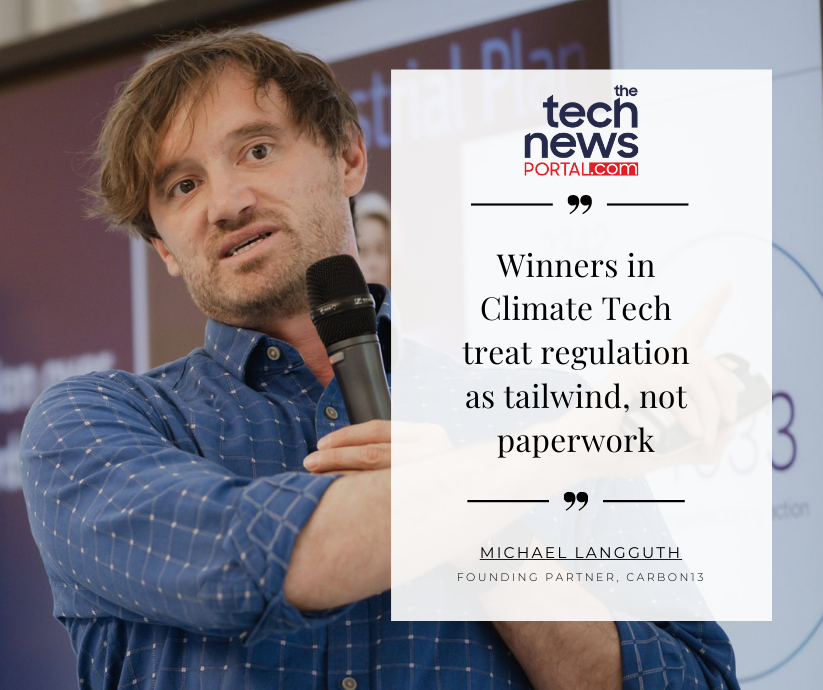
This intentionality extends to regulation. Major EU policy shifts, such as the Green Deal and mechanisms like the Carbon Border Adjustment Mechanism (CBAM), must be treated “as an operating condition, not an externality.” Langguth argues that these regulations are effectively rewriting value chains. Ventures are advised to build compliance and data traceability into their product architecture early, using regulation as a “wedge” to become the preferred supplier in markets that are being forced to decarbonize.

Cracking the Bottleneck of Bureaucracy
Looking toward the next horizon, Langguth identified the largest overlooked opportunity for artificial intelligence outside of generative design: tackling institutional friction.
In sectors like grid upgrades, water systems, and industrial siting, he noted that AI is “massively underused in the messy, physical world of infrastructure planning and permitting.” The greatest breakthrough will be the AI systems that can compress the “multi-year planning, optimisation, and risk modelling cycles” that currently delay climate deployment by a decade.
The firm’s commitment to building “fundable precision” is its countermeasure to the Series B and C capital gap observed in European climate tech. This means pushing founders to secure validated customer economics, early corporate partnerships, and a defensible technology roadmap—all metrics later-stage investors actually underwrite.
Ultimately, Carbon13 is not waiting for technological miracles; it is systemically building a fleet of companies engineered for planetary impact. In Langguth’s view, the race to net zero will be won by those who possess both scientific depth and a “brutal focus on cost parity,” creating technologies that are disruptive in the lab but deeply compatible with the real-world value chain. “Whoever cracks the ‘bureaucracy bottleneck’ with AI will unlock trillions in delayed climate projects,” he concluded, summarizing the high-stakes, high-impact mission now underway.