
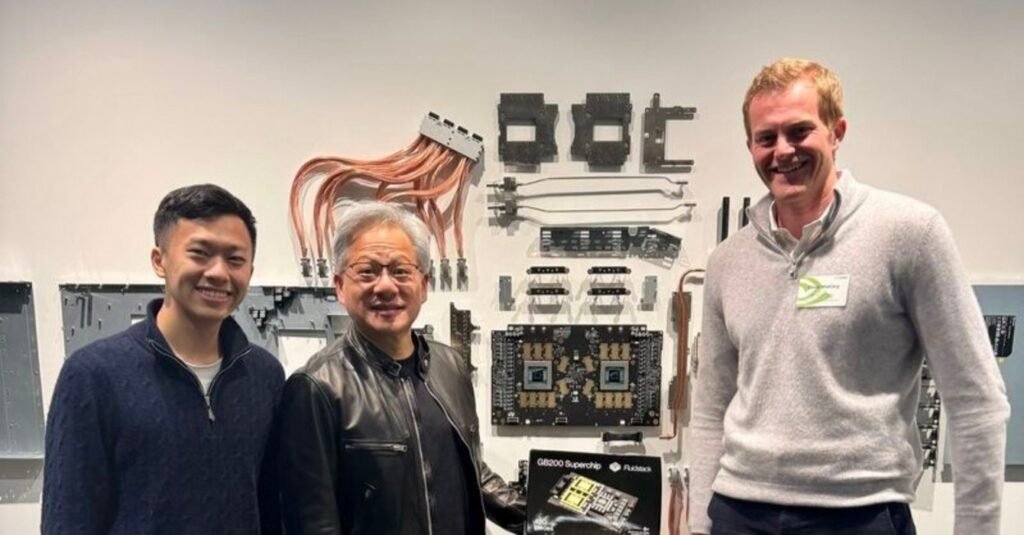
Fluidstack, a cloud-computing startup, is preparing to close a fresh funding round worth nearly $700 million, according to people familiar with the matter. The round would give the startup a valuation of around $7 billion. The next round of the potential transaction will be led by Situational Awareness, the investment company established by ex-OpenAI researcher Leopold Aschenbrenner.
Google wants to participate in the round while Goldman Sachs is the bank on the deal. The raise, if it happens, will be one of the largest financings of neocloud companies to date. Neocloud companies are those that lease high-performance computing capacity to AI developers and enterprises that are heavy on the use of such capacities.
Fluidstack’s rise is closely related to the worldwide demand for computing power that is exponentially growing due to AI. The race of the companies to train larger and larger models leads to accelerating data centre construction all over the world. So, the investors frequently now call this trend a digital infrastructure gold rush of the modern age.
Once it was a relatively unknown actor, but now the company has made a rapid transition into the limelight as an infrastructure provider of the new generation, i.e., neocloud companies. The latter are setting themselves up as the future main suppliers to AI developers who need huge and at the same time very reliable access to GPUs and other fast chips.
Major technology firms—most visibly Microsoft—have thrown in hundreds of billions of dollars to guarantee long-term compute access by means of partnerships and investments. By Fluidstack’s recent move of its main office from the UK to New York, the company shows that it wants to confront the global competition more directly. For the attending investors, the startup is located at the crosspoint of two huge forces: the AI boom and long-term infrastructure investment.
High-stakes financing models redefine the market
Besides, Fluidstack, which was established by Gary Wu and Cesar Maklary, is willing to lead the way in creating non-traditional financing structures for data center developments. The firm has made two substantial agreements with Google with respect to data centre initiatives held in conjunction with crypto mining companies TeraWulf and Cipher Mining over the last 12 months.
Within these deals, Fluidstack has committed to the construction of large-scale facilities that will predominantly be financed by loans, while Google will provide a financial “backstop” to support the payment of creditors if the company defaults on its obligations. The format is very much like the recent moves by Meta that financed a similar infrastructure project with almost $60 billion while doing a large chunk off their balance sheet.
The enormous funding needs of AI infrastructures have a big impact on how project financing looks nowadays. In this new role, which is somewhat different from that of a software or cloud reseller company, the likes of Fluidstack are turning into global infrastructure builders who also take on new funding models widely used by energy, utilities, and real estate development sectors.
The ambitions of Fluidstack are not limited to the US only. At the beginning of the year, French president Emmanuel Macron named the company as a key component of France’s national AI strategy. In February, the company revealed its plans to spend ten billion euros to build a colossal AI “supercomputer” in France.
Once completed, the facility, scheduled to go into service in 2026, will have a capacity of one gigawatt, making it one of the most powerful computing centers in the whole of Europe. The project gives an indication that the governments are increasingly treating AI infrastructure as a strategic national asset.
High stakes as investors race for compute capacity
The customer base of Fluidstack already includes large corporates such as Meta and Honeywell and a fast-growing list of technology startups that are scaling quickly. As the race to secure dependable compute capacity becomes fiercer, the result of this funding round will have far-reaching consequences for the neocloud sector.
If a $700 million fundraising is accomplished, besides that it will be the factor that stands behind the leadership of Fluidstack as a provider of AI infrastructures, it will be also a signal of the broad underlying transformation: that the computing infrastructure, which had been considered as a basic digital utility, is definitely one of the most valuable investment battlefields of the present decade.