
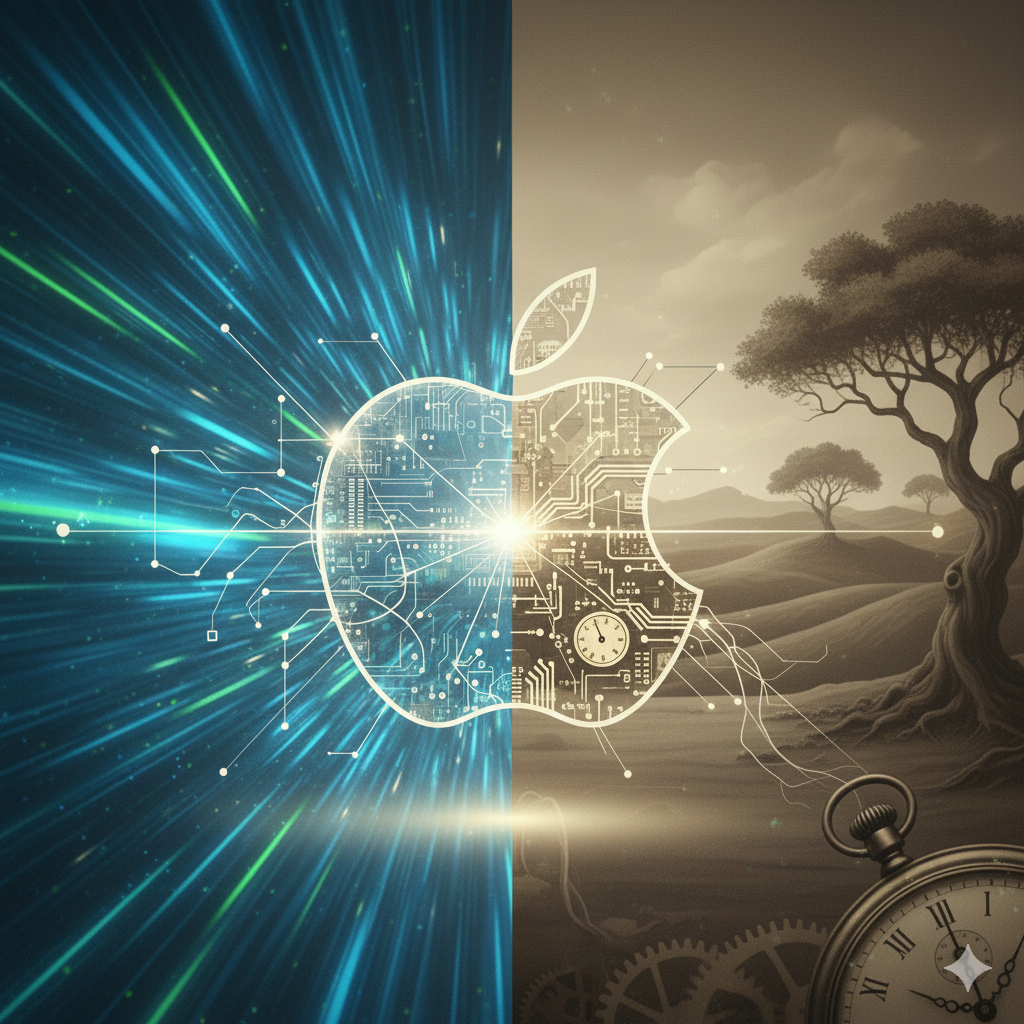
Every member of Big Tech has made its move. Microsoft with OpenAI and Azure AI. Google with Gemini. Amazon with Bedrock. Meta with Llama.
And Apple? No flagship model. No flashy platform. Just silence … punctuated by delays.
At first glance, it looks like Apple has stumbled. The next-generation Siri, once promised with iOS 18, is now pushed back to 2026. A hybrid approach collapsed under its own architecture. Morale dipped, key AI talent was poached, and Apple had to reshuffle leadership, moving its AI head aside and handing the reins to Mike Rockwell, the executive behind Vision Pro.
But step back. This isn’t new. Apple has a history of arriving late and then resetting the market on its own terms. The iPod wasn’t the first MP3 player, nor was the iPhone the first smartphone. What Apple does extremely well is transform messy technology into seamless experience.
That may be exactly what is happening again.
Craig Federighi, SVP of Software Engineering, admitted the first Siri redesign “couldn’t meet Apple’s standards.” So Apple scrapped it, pivoted to a full LLM-based Siri, and doubled down on investment. In the meantime, they’re running tests with both internal models and external partners like OpenAI, Anthropic, and even Google Gemini. Crucially, these are designed to run inside Apple’s Private Cloud Compute, aligning with the company’s privacy-first DNA.
Which brings us to the possibilities of what real play for Apple could be.
- Local AI execution. Apple’s silicon already integrates tightly with its software. Running models on-device makes AI instant, seamless, and private — exactly the kind of invisible magic Apple prizes.
- Multimedia AI. An iPhone that lets you capture a photo, say “make it golden hour,” and watch it transform in real time. Or a device that becomes a studio-grade recorder and editor for the social media economy.
- Cross App Intelligence. Think mem.ai++ on your fingertips, only you don’t have to store data. It knows everything on your device or even across all your Apple devices.
- Protection as a platform. Apple can let AI flourish in the App Store while enforcing data protection rules that others won’t. Innovation, but in a walled garden of trust.
- The safe cloud. A version of iCloud rebuilt for the AI age: encrypted, private, and free from the surveillance business models of competitors.
Apple’s silence may not be its absence. It’s restraint to play the game it is best at, not the game that is in fashion. Its delays aren’t weakness. They’re discipline of not rushing in with half baked experience.
Apple doesn’t need to build the biggest model. Its power lies in redefining how we experience AI. When it finally moves, it won’t be to compete with ChatGPT. It will be to create the next iPhone moment.
And here’s the crucial difference: Apple can afford a year’s delay. Its moat — a billion devices in people’s hands, the stickiest ecosystem in consumer tech, and unmatched brand trust — means there is no immediate threat to its core business. Others are racing to capture market share. Apple already owns it.
The open question: is Apple late? Or is it simply working quietly to make the defining play?
What do you think? Has Apple stumbled in the AI gold rush, or is it setting the stage for defining an entirely new category of experiences?
(The article was originally published by the Author on LinkedIn, has now been used on The Tech News Portal as Guest Opinion)