
French start-up Rift has raised €4.6 million to further develop its concept of the first real-time aerial intelligence network in Europe, a network that, according to the company, could have a profound impact on how emergencies and essential infrastructure are monitored throughout the continent.
The money raised, which was mainly from AlleyCorp, with OVNI Capital also investing, will be Rift’s tool to the full deployment of the drone station network as well as the advancement of the technology that would make the request for surveillance on the fly feasible. France-based remote command centre is where the company plans to run this network of drones.
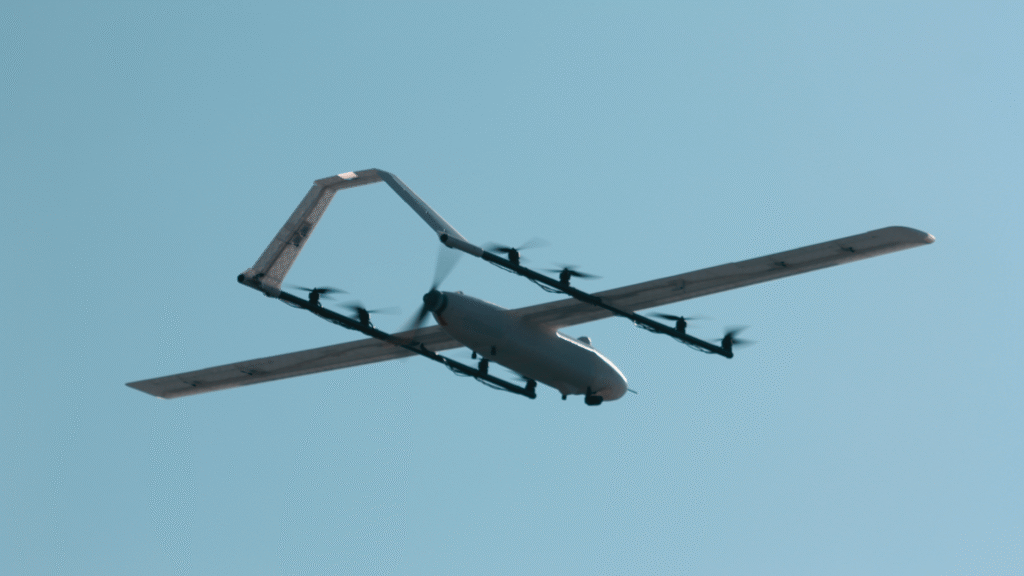
Rift, created as a response to what it defined as the increasing “geopolitical and climate risks,” is determined to fi.rst take the aerial security systems in use now to another level by making them more economical and scalable. Their answer is what they termed “Surveillance-as-a-Service”- long-endurance VTOL drones that are capable of providing continuous coverage of borders, critical infrastructure and security of sensitive sites.
Rift’s co-founder and CEO Daniel Nef gave an example of one of their main applications by saying that their goal is to change the way emergency response works. “Our mission is to change the way emergencies are managed today by giving access to real-time aerial information,” he said. “Rift is concentrating on constructing the first European airborne intelligence network that is self-reliant and dedicated to public safety and vital infrastructure. The firm itself believes that it is bridging ‘the gap between satellites and ground teams’ which it calls the liaison,'” he added.
The company envisions its offering as a solution for the rapid identification of wildfires in their incipience, the visual recording of highway crashes, the documentation of illegal border crossing as well as the surveillance of pipelines, power lines and railways against leaks and intrusions. A long-endurance VTOL drone, an autonomous deployment unit and the company’s proprietary RiftOS software will be located in each Rift station.
With this fresh capital injection, Rift is determined to implement its plans to the full extent over the next two years in the form of deployment operations, research and development, go-to-market strategy and regulatory readiness sectors. To be able to keep up with this growth, the company is looking to expand its workforce by up to fifty people.
“The injection of these funds is instrumental in accomplishing two main goals: the physical establishment of more than twenty fully autonomous stations along borders and critical infrastructures, and performance of complete mission autonomy, including data exploitation from mission planning, by the year 2027. This growth will also enable Rift to obtain the SAIL III/IV regulatory clearances it needs to expand to the EU widespread,” Nef stated.
Rift has identified three sectors that could benefit the most from its surveillance platform in the shortest time – maritime surveillance, infrastructure corridors and public safety. The company intends to launch its product in different stages, with maritime surveillance as the first stepping stone and later adding national infrastructure networks and public safety systems.
Mr. Nef made a point by saying that the infrastructure operators had better get used to more frequent inspections of their aging assets, which was a positive thing in terms of technology adoption. “The immediate adoption of our product will be driven by the transition of inspection methods for infrastructures. Infrastructures that are old and of which new regulations require that they be checked more often will see their inspection frequency increase drastically from 1-2 times per year to perhaps 6-48 times per year by 2030 for sectors such as power lines and pipelines, which in turn will create a continuous demand that Rift will be able to meet,” Mr. Nef said.
In order to rapidly increase its production, Rift is adopting new methods of manufacturing. The company claims that its long-endurance VTOL drones are made from 3D-printed carbon fibre composite — a technique that is four times faster than traditional methods and significantly more economical. According to Nef, a Rift drone costs €4,000 to produce, compared to €25,000 for a normal industrial VTOL platform.
Rift only integrates the airframe and software parts internally while the rest of the system comprises of commercially available components. This, according to Nef, helps the company to avoid “R&D bloat, supply chain friction, and CAPEX traps” which often result in the slowing down of the aerospace field. The firm claims that it has managed to reduce the time from design to flight to three days, thus facilitating rapid testing and continuous updation in the actual environment.
As Europe is confronted with changing climate threats, border issues, and increasing infrastructure needs, Rift believes that its drone network, operating independently, might turn out to be the most vital security and emergency response tool of the region.