
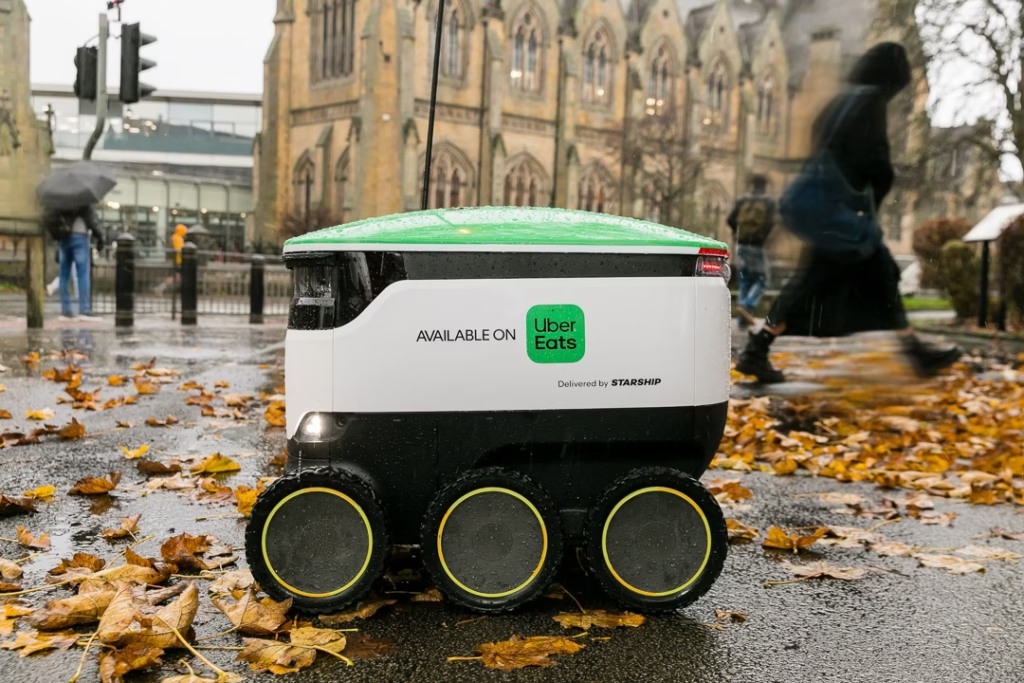
Starship Technologies and Uber Technologies have announced a global partnership to roll out autonomous sidewalk robot deliveries across the UK, Europe and the United States, marking one of the most significant steps yet in the evolution of last-mile logistics.
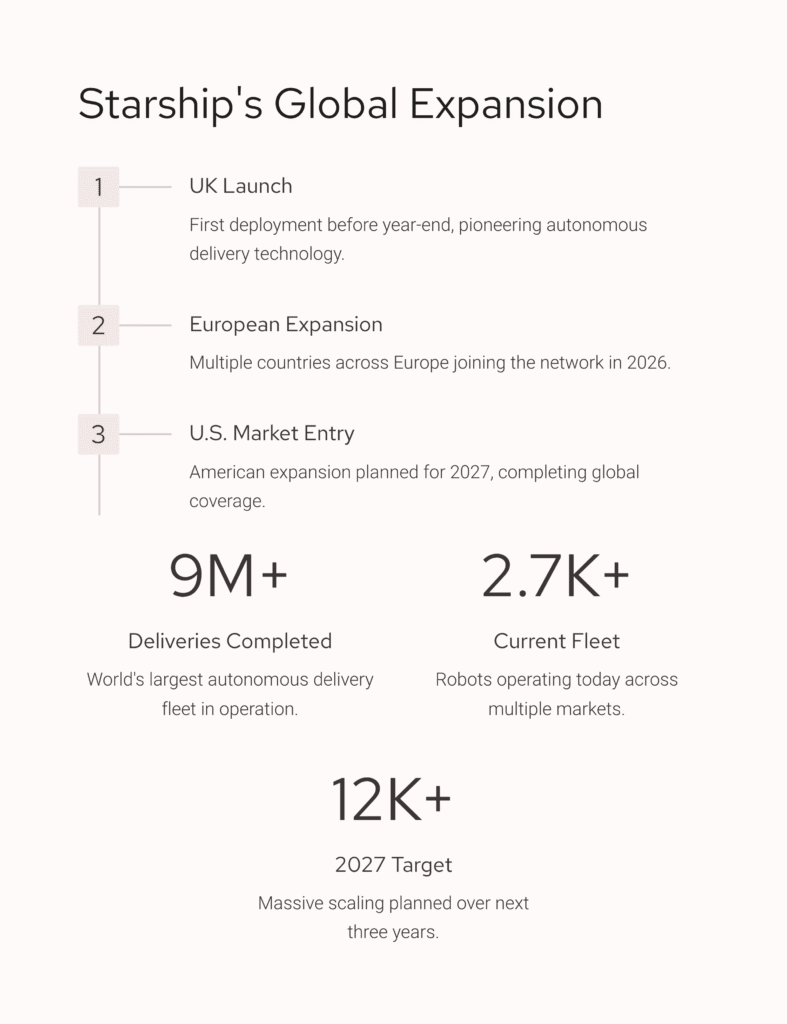
The collaboration will begin delivering results almost immediately, with the first commercial deployment scheduled in Leeds in December 2025. Multiple European markets will follow in 2026, while expansion into the U.S. is being planned for 2027.
The move brings together two major forces in mobility and automation. Uber Eats, one of the world’s largest delivery platforms, will integrate Starship’s AI-powered autonomous robots to offer what both companies describe as “next-generation delivery experiences” to consumers and merchants.
Starship Technologies – founded in 2014 by Ahti Heinla and Janus Friis, the team behind Skype – currently operates the world’s largest autonomous delivery network.

Heinla, co-founder and chief executive of Starship, said the partnership is a natural progression for a company that has spent more than a decade refining autonomous operations in real-world environments.
“Together, we’re building the infrastructure that will define the next generation of urban logistics,” he said. “Uber Eats has built the world’s leading delivery platform, trusted by millions across 10,000 cities. We bring scalable autonomous technology that works profitably at city scale.”
Heinla added that almost all major delivery platforms now use Starship robots, underscoring growing global confidence in the company’s capabilities. “I am excited to be helping Uber Eats, and also consumers in the UK and elsewhere,” he said.
The robots to be deployed in the UK this December will operate at Level 4 autonomy, meaning they can navigate streets, crossings and obstacles without human intervention. Designed to complete deliveries of up to two miles in under 30 minutes, they are built to operate reliably in varying conditions, including rain, snow and uneven pavements.
Sarfraz Maredia, Global Head of Autonomous at Uber, said the partnership marks an important milestone in the company’s broader vision.
“Autonomous delivery is an exciting part of how we see the future of Uber Eats,” he said. “Together with Starship, we’re bringing this future to life across multiple continents, leveraging Uber’s global scale and Starship’s proven autonomy to deliver efficient and affordable experiences for consumers and merchants everywhere.”
Over the past 11 years, Starship’s robots have operated in more than 100 cities across 15 countries, performing over 100,000 road crossings every day. This extensive real-world exposure has enabled the company to build a dataset of around 200 million crossing-related data points, which continually trains and improves its AI navigation systems.
The company also recently strengthened its financial standing, raising $50 million in October 2025, pushing total funding past $280 million.
Uber, meanwhile, continues to broaden its role as a mobility, delivery and logistics platform. Since launching in 2010, the company has facilitated more than 68 billion trips worldwide.


With the new partnership, both companies say the future of urban delivery will be faster, more reliable and increasingly autonomous – a transformation that could reshape how households across the world receive food and everyday essentials in the years to come.
Starship Technologies and Uber Technologies have revealed a worldwide partnership to introduce autonomous sidewalk robot deliveries in the UK, Europe, and the United States. This marks one of the significant steps of the last-mile logistics evolution.
The collaborations are not far from their results as the first commercial deployment is scheduled in Leeds in December 2025. Numerous European markets are going to follow the lead in 2026, while the U.S. area expansion is scheduled for 2027.
The move merges the two giants of mobility and automation into one force. Uber Eats, one of the largest delivery platforms worldwide, is to integrate Starship’s AI-powered independent robots to offer what both companies describe as “next-generation delivery experiences” to consumers and merchants.
Starship Technologies – the team behind Skype – which was started in 2014 by Ahti Heinla and Janus Friis, is the largest provider of autonomous delivery worldwide, with its network and fleet of over 2,700 robots having completed over 9 million deliveries in seven different countries and over 270 different locations. The company is planning to increase that number to over 12,000 robots by 2027.
Ahti Heinla, co-founder and CEO of Starship, said the agreement is a natural move for a company that has evolved through ten years of experience of the most advanced and complex operations of autonomous devices in the real world.
“With this,” he stated, “we are creating the blueprint of cities and urban logistics of the future.” Uber Eats, one of the most efficient delivery platforms, trusted by millions across 10,000 cities, is what the world has seen till now. But we come in with scalable autonomous technology that can work profitably at city level.”
Heinla also claimed that just about every big delivery platform has now equipped Starship robots as a result of her global trust in the company’s abilities. “I am really excited about the prospect of helping consumers in the UK to be served by Uber Eats and other things as well,” he said.
The robots that will be sent to the UK in December will be equipped with Level 4 autonomy, which means they will be able to find their way through the streets, different types of crossings and obstacles without needing a human to intervene. They are intended to be the ones to complete deliveries of less than two miles and within 30 minutes, and they are also designed to work regularly in different types of weather that may include rain, snow, or even uneven pavements.
Sarfraz Maredia, Global Head of Autonomous at Uber, said this collaboration was an essential step towards Uber’s bigger vision.
“Autonomous delivery is an exciting part of how we see the future of Uber Eats,” he said. “We, together with Starship, are making this future real not just in one but in several continents. This is made possible by Uber’s global presence and Starship’s tested autonomy thus we can offer a solution that is efficient and affordable not only for consumers but also for merchants everywhere.”
During the 11 years that Starship’s robots have been in operation, they have carried out tasks in more than 100 cities of 15 countries and have been involved in over 100,000 road crossings daily. This extensive exposure to real-life scenarios has given them the opportunity to amass a large dataset of approximately 200 million data points related to crossings that are used for continuous training and upgrading of their AI navigation systems.
The company also recently made its financial situation stronger by raising $50 million in October 2025, thus the total capital raised is now more than $280 million.
In the meantime, Uber is not limiting itself and continues to expand its role as a platform for mobility, delivery, and logistics. The company, which started its operations in 2010, has been a facilitator of more than 68 billion trips worldwide.
With this new agreement, the two companies assure that the next-urban delivery will be quick, trustworthy, and more and more autonomous- a change that might have a major impact on the way in which households all over the world will get food and other daily necessities in the near future.